
A leaking bottle in the diaper bag at three in the morning, a pacifier that the infant refuses after two attempts, spare parts that are nowhere to be found at the pharmacy on a Sunday: you don’t choose a bottle based on a technical sheet, you choose it based on what it demands in daily life. Mam and Avent dominate the French market, but their design logics diverge on points that parents often discover too late.
Cleaning and sterilization: what really changes between Mam and Avent
The Mam Easy Start bottle disassembles into three distinct parts: the body, the ventilated base, and the nipple. This removable base makes it easier to clean the inside without a bottle brush in most cases. It also allows for microwave self-sterilization in three minutes, directly in the body of the bottle filled with a bit of water. No need for a separate sterilizer.
The Philips Avent Natural Response bottle adopts a more classic design: body, ring, and nipple. Cleaning requires a standard bottle brush. For sterilization, Philips offers a dedicated sterilizer or boiling water. The difference may seem minor on paper, but when you go through six bottles a day, the time savings with Mam on sterilization accumulate.
By consulting the comparison of Mam and Avent bottles on bebecolor.com, this observation is confirmed: the practicality of the Mam system appeals to parents who travel or who do not have an electric sterilizer available.
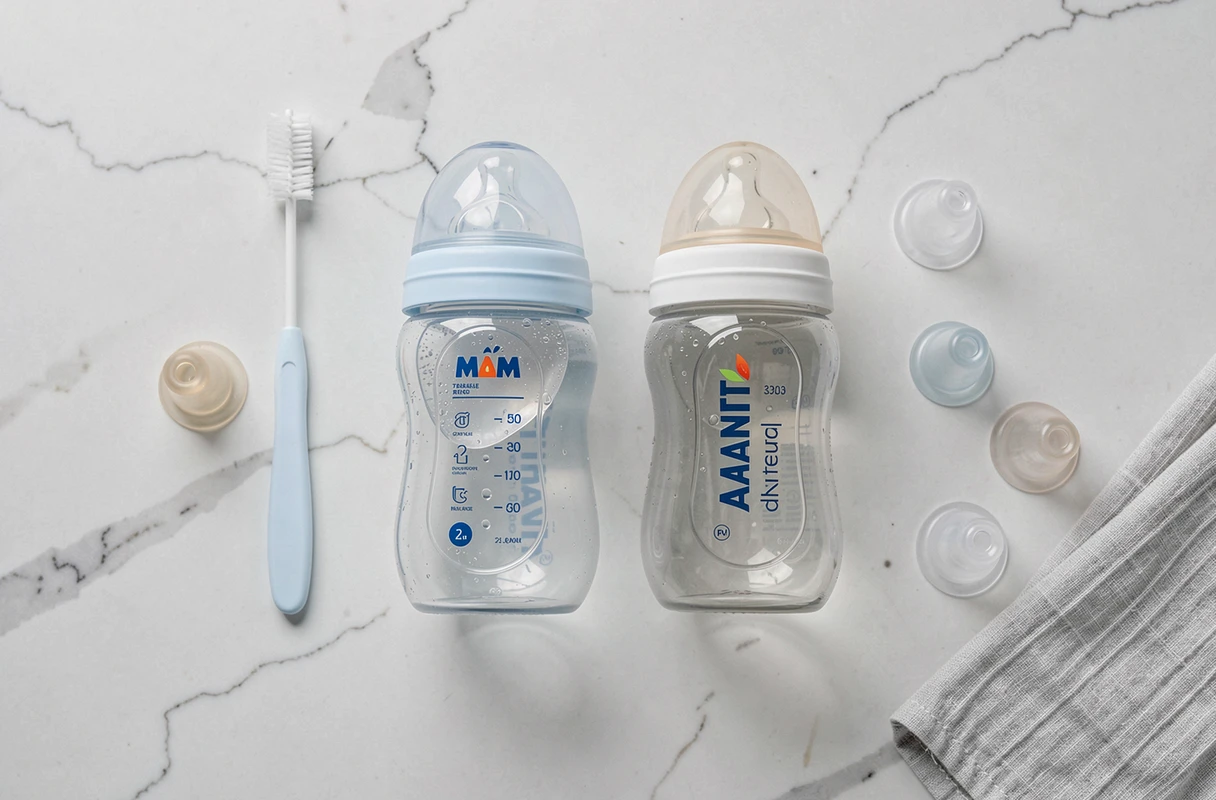
Mam or Avent bottle nipple: two approaches to sucking
The Mam SkinSoft nipple is flat, soft, with a texture that resembles skin. It is often better accepted by breastfed babies who refuse traditional nipples. The flow remains consistent, which suits infants who drink without interruption.
The Avent Natural Response nipple works differently: milk only flows when the baby actively sucks. Between two sucks, the flow stops. This mechanism replicates the natural rhythm of breastfeeding, with spontaneous pauses. For a baby on mixed feeding, this logic facilitates the switch between breast and bottle.
Which flow to choose according to age
Both brands offer nipples with progressive flow, but compatibility between generations of bottles varies. With Avent, the Natural Response nipples are compatible with the entire current Natural range. With Mam, the nipples are specific to each model (Easy Start, Easy Active). Before buying a replacement pack, check the exact reference.
- Flow 1 (birth): suitable for the first months, both brands provide it by default with their newborn bottles
- Flow 2 (from about two months): to be tested according to the baby’s behavior, some infants stay on flow 1 longer
- Flow 3 and beyond: useful when the baby gets frustrated with a flow that is too slow, but feedback on this point varies among children
Anti-colic bottles: Avent valve or Mam ventilated base
Infant colic remains the primary reason parents switch bottles. Both brands claim to have an anti-colic system, but the mechanism differs.
Mam uses a ventilated base that allows air to enter from the bottom of the bottle. The air does not pass through the milk, which limits bubble formation and reduces the amount of air swallowed. This system works well, provided the base is properly screwed on after each cleaning.
Avent integrates an anti-colic valve into the nipple itself. On some models, a complementary AirFree valve prevents air from mixing with the milk even when the bottle is held horizontally. This device is particularly suitable for babies who drink in a semi-reclined position.
In practice, no bottle completely eliminates colic. The choice between the two systems depends more on the feeding position and the baby’s digestive sensitivity than on any technical superiority of one over the other.

Replacement parts and bottle evolution between 0 and 6 months
A criterion that parents often overlook: the availability of spare parts in supermarkets and pharmacies. Philips Avent benefits from a wider distribution network in France. Its replacement nipples can be found in most supermarkets and pharmacies. Mam is well established in pharmacies, but its specific references (ventilated base, Easy Start nipples) are sometimes out of stock in general stores.
Glass or plastic depending on the brand
Avent has expanded its Natural Response range with borosilicate glass bottles, an interesting option for parents who want to avoid plastic from birth. Glass is heavier, but it does not retain odors and can be sterilized without special precautions.
Mam also offers glass bottles, but the range is less developed than Avent’s. For the first months, glass is suitable (the baby does not hold the bottle). As soon as the child starts to grasp on their own, switching to plastic or a model with a protective sleeve becomes necessary.
- From 0 to 3 months: glass is a viable option, the bottle remains in the parent’s hands
- From 3 to 6 months: the baby starts to grasp, consider a lighter bottle or a silicone sleeve
- Beyond 6 months: both brands offer training bottles with handles, but the formats differ
The choice between Mam and Avent rarely hinges on a single criterion. A baby prone to colic will lean towards the Mam ventilated base, while a breastfed infant will benefit more from Avent’s demand-feeding mechanism. For parents, Mam’s quick sterilization saves time, but Avent’s distribution network simplifies restocking. The most reliable approach is to buy one bottle from each brand and let the baby decide.