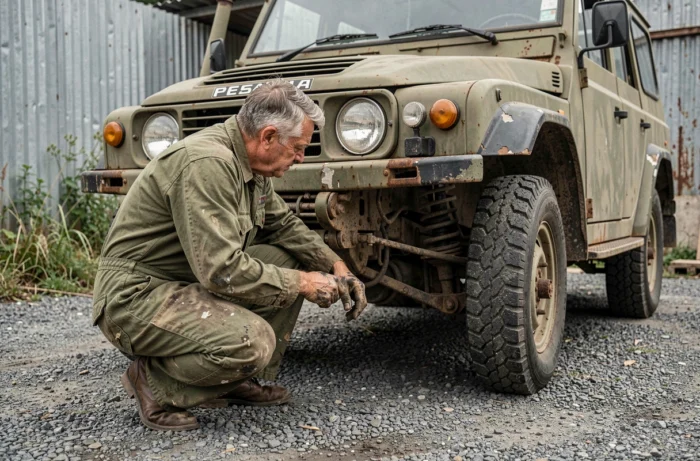
The decommissioned Peugeot P4 arrives in the hands of its new owner with a military past that is evident in every component. Before considering heavy modifications, the priority lies in the mechanical and electrical systems, the condition of which determines everything else. Comparing interventions by order of impact and cost allows for prioritizing work without wasting budget on secondary areas.
Mechanical Diagnosis of the Decommissioned P4: Key Areas to Inspect First
A P4 that has come out of military stocks has often operated under difficult conditions, but with maintenance governed by strict procedures. The paradox is that some components are in better condition than those on a civilian vehicle of the same age, while others have been pushed well beyond their theoretical lifespan.
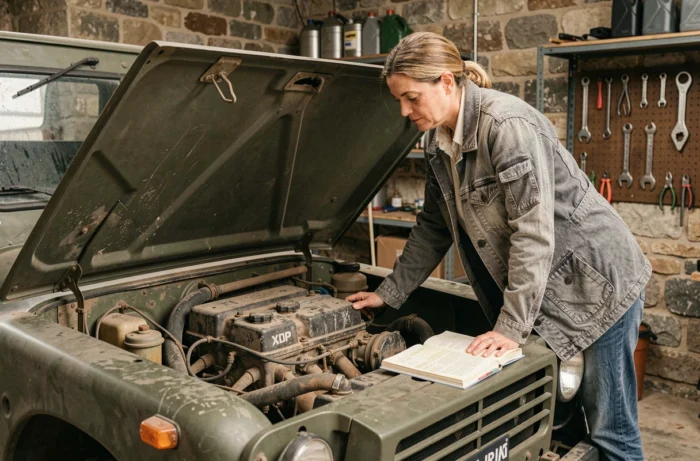
The first step is to sort out consumables and the engine peripherals before any modifications. Cooling hoses, belts, brake lines, battery: these elements age due to time as much as use. On a vehicle stored for several months or years after decommissioning, rubber deteriorates even when stationary.
The 4×4 communities documenting their P4 restorations converge on one point: reliability always precedes preparation. Restoring the cooling system, checking the levels of the differential and transfer case, and inspecting the condition of the drive shafts and boots represent the foundation without which no improvement makes sense.
For those looking to improve a decommissioned Peugeot P4, this diagnostic phase directly guides the budget towards the right areas.
Gasoline and Diesel Versions of the P4: How the Engine Type Affects Improvements
The P4 was produced in several configurations, and the distinction between gasoline and diesel versions affects the nature of the improvements that can be made. The body and equipment variants depending on usage (combat units, gendarmerie, firefighters, administrations) also influence the availability of parts.
| Criterion | Gasoline Version (XN1) | Diesel Version (XD3) |
|---|---|---|
| Availability of engine parts | Rarer, frequent reliance on used parts | Engine shared with other Peugeot models, parts more accessible |
| Low-end torque | Decent but less suited for slow off-road | Marked advantage for crossing |
| Fuel consumption | High | Significantly lower |
| Ease of maintenance | Simple mechanics, little electronics | Simple mechanics, mechanical injection |
| Engine optimization potential | Limited without heavy modifications | Room for improvement in the fuel system and exhaust |
In diesel versions, the XD3 engine is found in other Peugeot vehicles of the same era, making it easier to source new or refurbished parts. In contrast, gasoline versions require more research to find compatible components.
Precisely identifying the version of the P4 before purchasing parts avoids costly mistakes. The serial number and manufacturer’s plate provide information about the engine type, gearbox, and original configuration.
Running Gear and Corrosion on a Peugeot P4: Two Low-Cost, High-Impact Projects
Feedback from P4 owners shows a clear hierarchy: running gear and corrosion prevention top the list of projects that transform the vehicle’s behavior without breaking the budget.
Running Gear and Steering
The bushings, steering joints, and shock absorbers endure significant stress in military use. Their replacement restores road handling and driving comfort that the P4 had gradually lost.
- Replace the leaf spring and stabilizer bar bushings, often hardened or cracked after years of service
- Check the steering joints and play in the box: a P4 that “floats” at road speed often suffers from a worn box rather than a geometry defect
- Install new shock absorbers suited to the intended use (road, track, or crossing) to regain proper travel
- Inspect the condition of the front and rear hubs, particularly the bearings and axle seals
A renewed running gear radically changes road behavior, for a moderate investment compared to an engine intervention.
Corrosion Treatment
The chassis and longitudinal beams of the P4 are robust, but the original military paint does not protect indefinitely. Sensitive areas are located at the leaf spring attachment points, under the wheel arches, and at the bottom of the body.
A treatment with penetrating anti-corrosion product, applied after sandblasting or mechanical brushing of affected areas, stops the progression of rust. Treating corrosion early preserves the structural integrity of the chassis and avoids much more costly reinforcement welding later on.
Electrical System and Lighting of the P4: Upgrading Without Starting Over
The electrical installation of a military P4 is basic by design. Few consumers, short wiring harnesses, a field maintenance logic. This simplicity is an advantage for restoration.
Common failure points involve oxidized terminals, loose grounds, and connectors exposed to moisture. A methodical cleaning of connections, followed by protection with dielectric grease, often suffices to resolve intermittent electrical issues.
- Replace the original bulbs with models that meet current road standards to pass the technical inspection
- Add an accessible battery cut-off switch from the cabin, useful in case of a short circuit on an aging harness
- Check the alternator and voltage regulator: a P4 that undercharges will wear out its battery in a few weeks
Electricity represents the area where the ratio of time invested to reliability gained is most favorable. A few hours of work with a multimeter and basic tools eliminate the majority of recurring failures.
The decommissioned P4 does not require spectacular transformations to become a reliable and enjoyable vehicle. The basic mechanics, running gear, corrosion, and electrical system form the four areas where every euro spent produces a tangible result. More ambitious modifications (reprogramming, transmission change, advanced off-road preparation) only make sense once this foundation is solidly restored.