The second, the first, or the final year: each level of high school imposes a different rhythm, workload, and stakes. Comparing these three years based on concrete criteria allows us to determine which one has the least pressure and why the answer varies depending on the fields and student profiles.
Workload and stakes by level: comparative table for second, first, final year
| Criterion | Second | First | Final |
|---|---|---|---|
| National exams | None | Anticipated French exams (written + oral) | Specialty exams, philosophy, grand oral |
| Weight in the bac score | Continuous assessment only | French + continuous assessment | Majority of bac coefficients |
| Number of subjects followed | Broad common core (about ten subjects) | Common core + 2 retained specialties + French | Common core + 2 specialties + philosophy |
| Orientation / file | Choice of specialties at the end of the year | Dropping a specialty, initial post-bac reflections | Parcoursup (file, wishes, motivation letters) |
| Perceived pressure | Adjustment to high school | Average | High (bac + orientation) |
This table highlights a clear imbalance. The second year remains the level with the least certification stakes: no national exam, no Parcoursup file to compile, no heavy coefficient to defend. The main stress is on adapting to the high school rhythm and choosing specialties.
To deepen this observation with concrete work paths, Mindtrap’s high school advice details strategies that work level by level.
General second year: why students perceive it as the easiest
The absence of national exams radically changes the situation. In the second year, grades contribute to continuous assessment without weighing heavily on a final exam. The program remains a common core: no specialization, no dominant coefficient.
The transition from middle school to high school generates adjustment stress (new classmates, larger institution, increased autonomy). However, once this hurdle is passed, the academic pressure remains significantly lower than that of the first or final year.
The trap of the second year: underestimating the choice of specialties
The relative ease of the second year can mask a strategic issue. The choice of specialties at the end of the year conditions the future path, the options available in the final year, and the coherence of the Parcoursup file two years later.
- A student interested in scientific studies should maintain a good level in mathematics from the second year, even if the subject does not yet weigh through a specialty coefficient
- The results of the continuous assessment in the second year appear in the school file sent to post-bac programs, making each trimester useful
- Exploring new subjects (economic and social sciences, engineering sciences) helps make an informed choice of specialties rather than by default
First and final year: where difficulty increases and why
The first year focuses on the anticipated French exams. The written and oral parts of the French bac represent a first national exam with a significant coefficient. For many students, it is the first confrontation with a high-stakes exam.
The final year accumulates sources of pressure: specialty exams, philosophy, grand oral, and the compilation of the Parcoursup file between January and March. The workload peaks, and time management becomes a determining factor for success.
The Parcoursup effect on the final year
The Parcoursup platform imposes a rigid schedule. Wishes must be formulated during a period when revisions for specialty exams are in full swing. This dual requirement (preparing for the bac and defending one’s orientation) explains why the final year is perceived as the most demanding year of high school.
Generative AI in high school: a new rule of the game since 2025
Since June 2025, the Ministry of National Education has published an official framework titled “AI in Education, Usage Framework”. This document allows students to use generative AIs only within a learning framework defined by the teacher, with human supervision over any significant impact related to evaluation.
Having an AI complete an assignment without authorization is now classified as academic fraud. This rule changes the way of working from the second year onward. Using AI as a comprehension tool (rephrasing a lesson, generating practice exercises) remains possible, but submitting work produced by AI without personal appropriation exposes one to sanctions.
Pix pathways dedicated to AI also become mandatory in the second year, adding a digital skill to validate that did not exist two years ago.
Succeeding in the easiest year: concrete methods for the second year
Taking advantage of the less intense rhythm of the second year to lay solid foundations makes all the difference in the first and final years. Three areas of work prove particularly beneficial at this stage.
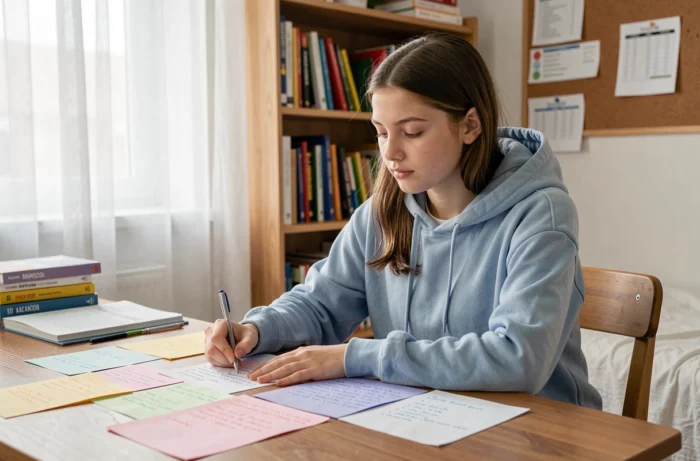
- Building a system of revision notes from the first trimester, subject by subject. This habit, established early, avoids overload during the anticipated French exams the following year
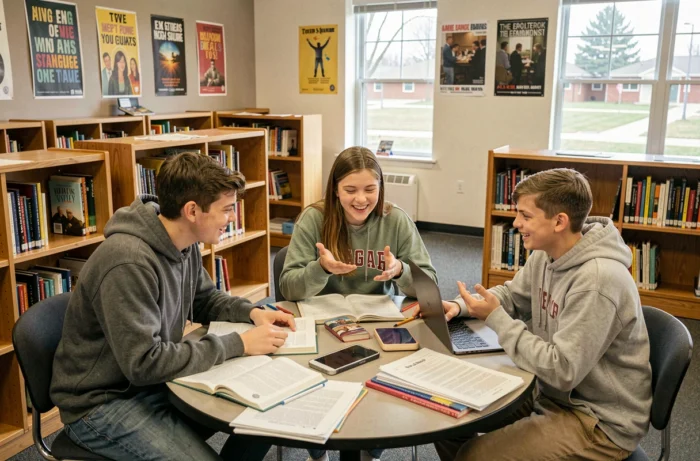
- Testing several study methods (active reading, timed exercises, group work) to identify the one that works before the stakes increase
- Actively participating in class: immediate understanding reduces revision time at home and improves continuous assessment without additional effort
The second year offers a space to experiment without heavy consequences. A trimester below expectations is easier to recover from than in the final year, where each evaluation weighs on the file.
The hierarchy of difficulty in high school follows a fairly predictable logic: the second year has the least certification stakes, the first introduces the first national exams, and the final year accumulates bac and orientation. Taking advantage of this progression means using the second year to build work methods that will pay off in the following two years.