
The garden tool market has shifted dramatically in just a few years. Traditional thermal catalogs now coexist with unified battery ecosystems, connected tools, and ergonomic ranges designed to reduce musculoskeletal disorders. In the face of this fragmented offering, the choice of garden equipment relies less on a checklist of tools and more on a reading grid adapted to the actual terrain configuration, regulatory constraints, and the chosen power source.
Unified battery or thermal: the criterion that structures the entire tool range
Most guides still compare “corded electric vs thermal.” This reading grid is outdated. The real decision today is about choosing a battery ecosystem, where a single cell powers the lawn mower, hedge trimmer, blower, and brush cutter.
The Mova SyncPack 20 V system illustrates this logic: all devices share the same batteries, and some can couple two to operate at 40 V. The practical gain is direct, as it reduces the number of chargers and batteries stored in the garden shed. STIHL takes the concept further with STIHL Connected, a device that allows real-time tracking of the status and location of devices and certain backpack batteries.
Choosing equipment on Tout pour le Jardin based on a battery ecosystem rather than machine by machine changes the economic calculation. The initial investment may seem higher, but the overall cost decreases from the third or fourth tool purchased in the same range, as the batteries and chargers are already acquired.
Field feedback diverges on one point: autonomy under demanding conditions. For a hedge of several dozen linear meters or a large lawn, a single 20 V battery may lack power. Switching to 40 V (two coupled batteries) or choosing a thermal model remains relevant.
Gardening noise regulation: an underestimated selection filter
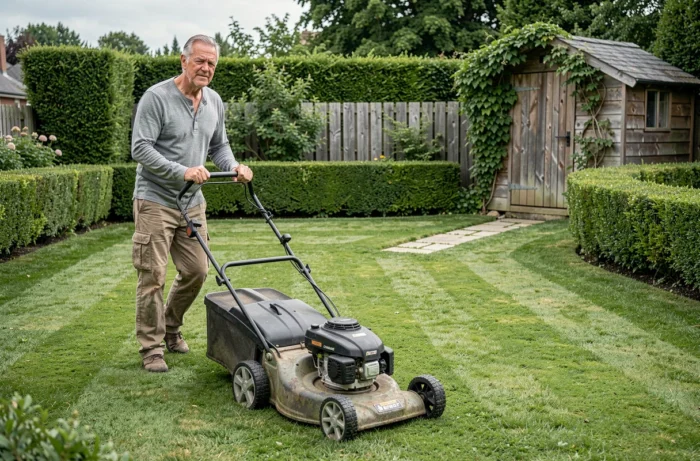
The choice of a motorized tool can no longer ignore regulations on noise pollution. The permitted time slots for using lawn mowers, hedge trimmers, or chainsaws vary by municipality, but a national framework sets clear limits.
- On weekdays, noisy gardening work is generally allowed from 8:30 AM to 12 PM and from 2 PM to 7:30 PM.
- On Saturdays, the time slot often narrows to between 9 AM and 12 PM, then 3 PM and 7 PM.
- On Sundays and public holidays, the time frame usually limits to 10 AM – 12 PM in many municipalities.
A battery-powered tool emits significantly fewer decibels than a thermal model, which practically widens the usage windows without risking neighborhood conflicts. This factor weighs heavily for gardens in dense residential areas.
Sanctions are not symbolic. A fixed fine may apply in case of proven noise pollution, and the theory of precedence (“I was here first”) does not systematically protect the noisy party. The type of motorization thus becomes a legal criterion as much as a technical one.
Ergonomics and suitable tools: an angle ignored by shopping lists
Classic guides line up spades, rakes, pruners, and lawn mowers without questioning their adaptation to the user’s body. Manufacturers, however, are developing specific ergonomic ranges, particularly for senior gardeners or those suffering from joint pain.
Concrete ergonomic criteria to check before purchase:
- The weight of the tool when loaded (including battery), not just the empty weight displayed on the product sheet.
- The presence of a harness or distribution strap for carried tools (brush cutter, backpack blower).
- The diameter and coating of the handle, which directly influence hand fatigue during a prolonged trimming session.
- The ability to adjust the height of the handlebar or telescopic handle without additional tools.
A tool that is too heavy or poorly balanced causes postural compensations that, repeated over a season, can lead to chronic pain in the back or shoulders. Price alone is not enough to assess the quality of equipment: handling it for a few minutes provides more information than any technical sheet.

Maintenance of garden equipment: what truly extends lifespan
Buying good equipment without maintaining it is akin to wasting your investment. Available data shows that the lifespan of a motorized tool depends more on the regularity of maintenance than on the chosen brand.
Cleaning the blades after each use limits the spread of plant diseases from one shrub to another. A simple wipe with isopropyl alcohol on a pruner or hedge trimmer is sufficient. For battery tools, storing the battery at room temperature (neither freezing nor extreme heat) preserves its charging capacity over several seasons.
Lawn mower blades gradually lose their sharpness, which increases energy consumption and tears the grass instead of cutting it cleanly. A sharpened blade reduces mechanical effort and improves cutting quality. Sharpening can be done with a file or by a professional, depending on the type of blade.
For tools with wooden handles (spade, rake, hoe), a light sanding followed by a coat of linseed oil at the end of the season prevents drying and the appearance of splinters. This gesture takes a few minutes and can double the longevity of the handle.
The choice of high-performance garden equipment relies on a set of filters rarely crossed in the same guide: compatibility with battery ecosystems, local noise constraints, ergonomic adaptation, and maintenance rigor. No tool is universally “the best”; it is the match between the terrain, the user, and the regulatory framework that determines the relevance of an investment.