Obtaining a house for free in France relies on specific legal mechanisms, each with its own constraints. Family donations, unclaimed properties, municipal programs at symbolic prices: these options exist, but their real cost often exceeds the displayed acquisition price. This article compares the main pathways to free or nearly free housing, measuring what each entails in terms of costs, timelines, and obligations.
Taxation of vacant properties in 2026: the game-changing lever
Most articles on free housing focus on acquisition devices. They overlook a crucial factor: the tax pressure on vacant properties pushes owners to relinquish their assets.
Municipalities in tight zones can now apply local rates significantly higher than the default regime. Paris voted on July 17, 2026, to activate maximum rates for vacant properties. This surcharge makes it financially unsustainable for some owners to retain an unoccupied property, particularly those who have inherited a home without plans for occupancy.
The new tax framework better distinguishes between “involuntary” vacancy and “voluntary” vacancy. An ongoing inheritance, major renovations, or a property for sale without a buyer remain cases of exemption under certain conditions. An owner who voluntarily leaves a property vacant without justification faces increased taxation.
This mechanism directly feeds the stock of properties offered at symbolic prices or as donations, and you can learn more on Immobilier Hebdo about the various concrete options.
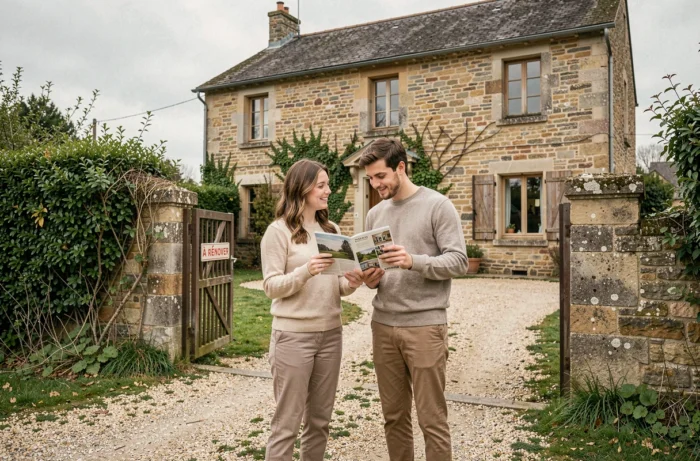
Comparison of pathways to free housing in France
The acquisition price represents only a fraction of the total cost. The table below compares the main solutions based on the criteria that matter: actual costs, average timelines, and eligibility conditions.
| Solution | Purchase Price | Non-negotiable Costs | Estimated Timeline | Main Condition |
|---|---|---|---|---|
| Family donation (exemption 2025-2026) | €0 | Notary fees, property tax | Several weeks | Direct family relationship |
| Unclaimed property (municipality) | €0 | Major renovations, administrative fees | Several months to several years | Decision by the municipal council |
| Municipal program “house for €1” | €1 | Mandatory renovations (often several tens of thousands of euros) | Variable by municipality | Commitment to residence and renovations |
| Vacant inheritance (reform 2026) | Variable (often symbolic) | Curator fees, notary, restoration costs | Long (administrative procedure) | Sale organized by the public curator |
| Adverse possession (usucapion) | €0 | Legal fees, compliance upgrades | 30 years of continuous occupation | Peaceful, public, and continuous possession |
The “non-negotiable costs” column reveals the gap between the promise of free housing and the financial reality. Renovation represents the heaviest burden in each scenario, often far exceeding the price of a conventional purchase in rural areas.
Reform of vacant inheritances 2026: simplified access to abandoned properties
The curator now has expanded powers to expedite the sale of properties from unclaimed inheritances.
Specifically, the procedures for selling properties in vacant inheritance are shortened. Where joint ownership could block a property for years, the new regime allows the curator to act more swiftly, even without the agreement of all identified heirs.
This reform does not mean these properties become free. The sale remains regulated, and the price depends on the condition of the property and its location. However, it increases the volume of housing re-entering the market, some at very low prices in low-demand areas.
What the reform changes for a buyer
- The time between reporting a vacant property and its sale is reduced thanks to the curator’s enhanced powers
- Properties in blocked joint ownership can be sold without waiting for unanimous agreement from heirs, unlocking situations that have been stagnant for decades
- The municipality retains a preemption right, meaning an individual must check that the local authority does not have plans for the targeted property
Family donation with exemption: the most accessible scheme
Among all the pathways to free housing, the family donation remains the one that offers the best simplicity/effectiveness ratio. From February 15, 2025, until December 31, 2026, cash gifts intended for the acquisition of housing benefit from an exceptional exemption from donation rights.
Each donor can transfer up to €100,000 per beneficiary, with a global cap of €300,000 per donee. Eligible beneficiaries include children and grandchildren in direct line.
This scheme does not only concern the transfer of an existing property. It also covers the financing of a new purchase, significantly broadening its scope. The main condition remains the family relationship. For a buyer without a family network owning real estate, this option remains inaccessible.
Notary fees: the cost that “free” does not eliminate
Even in the context of an exempt donation, notary fees are still due and represent several thousand euros. The notary’s fees are calculated based on the value of the property transferred, not on the price paid. A property given for free but valued at a significant amount generates proportional fees.
Property tax, mandatory diagnostics, and any necessary compliance upgrades add to the budget. These items transform a theoretically free operation into a real investment.
Each pathway to free housing in France relies on a trade-off between the acquisition price and ancillary costs: renovation, taxation, procedures. The total cost of a “free” house regularly exceeds that of a conventional purchase in rural areas. The 2026 reform of vacant inheritances and the tax pressure on empty properties increase the number of available assets, but total free housing remains marginal, reserved for direct family donations within the limits of the current exemption scheme.