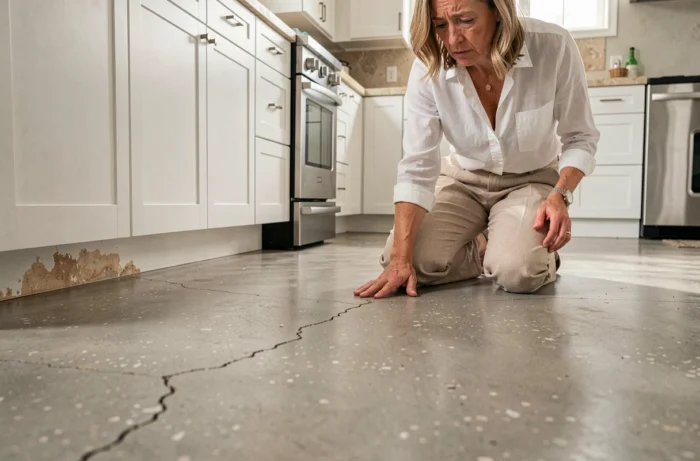
Quartz concrete attracts with its smooth surface, shiny appearance, and its reputation for durability inherited from the industrial world. Before choosing it as a flooring material, it is advisable to examine the technical and health constraints that its implementation and aging impose.
Crystalline silica: the health risk of quartz concrete that should not be ignored
Quartz is a mineral silicate rated 7 out of 10 on the Mohs scale. This hardness, often presented as an asset, generates a public health issue as soon as mechanical intervention occurs on quartz concrete. Sawing, grinding, drilling, and stripping release a fine dust of crystalline alveolar silica recognized as carcinogenic.
Wearing a mask is not enough. Effective prevention involves working wet or capturing dust at the source, which requires appropriate professional equipment. In France, regulations govern workers’ exposure during installation and renovation. A homeowner wishing to drill their floor or create a groove is therefore exposed to a real risk if they do not have the proper equipment.
This point remains poorly documented in consumer guides, which focus on the material’s aesthetics. Before validating the choice of quartz concrete, all future interventions (cable routing, partition fixing, localized repairs) must be anticipated, and the cost of associated health protection must be integrated.
Helicopter finishing: an installation that tolerates no errors
To fully understand the limitations of quartz concrete, one must consider the finishing process. This step, performed with a rotating mechanical trowel (known as a “helicopter”), solely determines the final quality of the surface. The timing of the intervention is critical: too early, the quartz sinks into still too soft concrete, and the hardened layer does not form correctly; too late, the powder no longer incorporates, and the surface remains heterogeneous.
A timing error permanently compromises the uniformity of the finish. There is no simple way to correct it. Local repairs remain visible because they do not recreate the original hardened layer. This level of demand makes the installation incompatible with amateur work.
Hiring an experienced professional increases the budget, but it is the only way to achieve a uniform result. Field feedback varies on the material’s tolerance to climatic conditions during pouring: temperature, humidity, and wind influence the setting time and further complicate the adjustment of the finishing outdoors.
Efflorescence and porosity of quartz concrete: lasting degradations
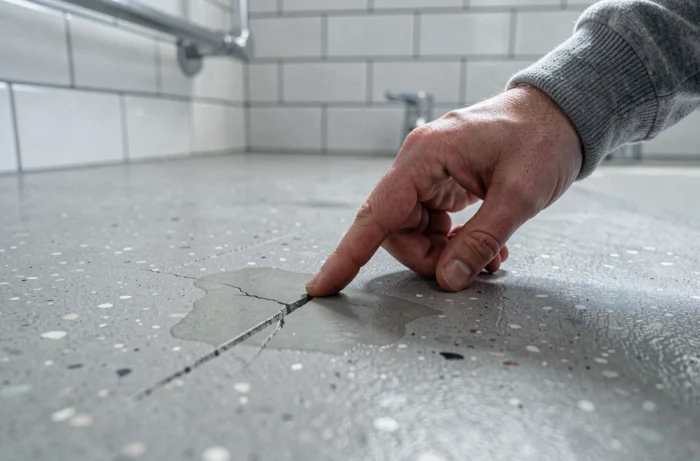
Quartz concrete remains a porous material despite its hardened surface layer. Water can migrate through the slab and carry dissolved salts to the surface. The result manifests as whitish deposits called efflorescence, visible in areas exposed to moisture.
These marks are not just an aesthetic defect. They can signal a deeper structural problem:
- A capillary rise related to the absence or failure of a moisture barrier beneath the slab
- Water infiltration through a crack or poorly executed joint
- Condensation in a poorly ventilated space
Cleaning efflorescence without addressing the source of moisture resolves nothing. The phenomenon reappears within weeks. A lasting treatment requires identifying and eliminating the source of water, which may involve significant work on the substrate.
Regular maintenance and protection with varnish
Aside from efflorescence, quartz concrete requires the application of a protective varnish to limit stain absorption, particularly in kitchens or bathrooms. This varnish must be reapplied periodically. Without this protection, colored liquids (wine, coffee, oil) penetrate the surface and leave permanent marks.
The concrete curing agent, applied immediately after pouring, limits rapid drying and reduces the risk of cracking. These two treatments are not optional but necessary to maintain the durability of the surface over time.
Quartz concrete in renovation: limited compatibility with existing substrates
Pouring quartz concrete over an existing substrate (tiles, removed carpet, old covering) poses adhesion and flatness issues that product data sheets rarely mention. The substrate must be perfectly clean, flat, and mechanically sound. A cracked old floor will transmit its cracks to the new covering.
The thickness of the necessary slab reduces the ceiling height, which can be problematic in the renovation of old apartments. The connections with door thresholds and other adjacent coverings require careful planning.
- The removal of old tiles also generates dust and logistical constraints
- The complete drying time of the slab requires several days without traffic in the room
- Finishes at the periphery (baseboards, expansion joints) are often underestimated in quotes
In renovation, quartz concrete competes directly with softer coverings that are easier to install, such as epoxy resin or thin-layer polished concrete. These alternatives do not offer the same mechanical resistance, but their implementation is significantly less demanding.
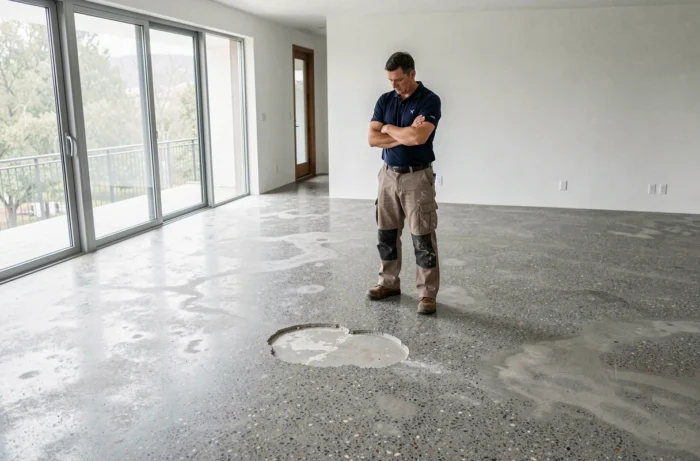
The choice of quartz concrete remains relevant for large surfaces subjected to heavy traffic (garage, workshop, commercial space). For typical residential use, the cost-benefit ratio should be evaluated on a case-by-case basis considering the existing substrate, maintenance budget, and the ability to engage a qualified installer.
A flooring material that requires as much caution in installation as in use is not a bad product, but it demands a commitment that not all projects justify.