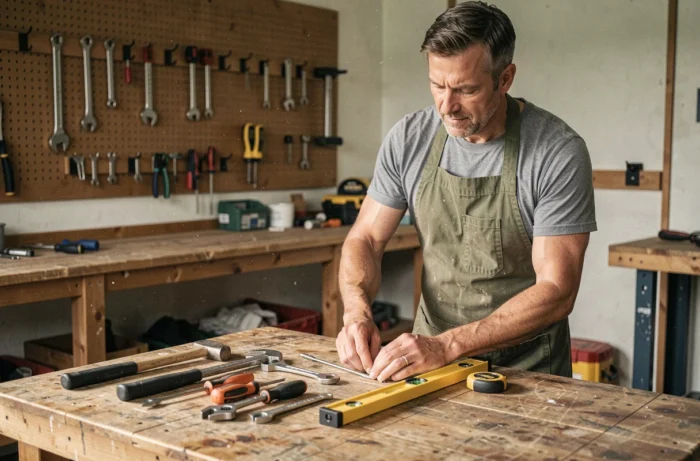
Hanging a shelf, tightening a door handle, sanding a flea market find: these small everyday projects share a common point. Without the right tool at hand, they quickly turn into frustration. Assembling a beginner’s toolbox doesn’t require an extravagant budget, but some thoughtful choices regarding the type of tools, their quality, and durability.
Five hand tools that cover most household tasks
Before thinking about machines, a beginner DIYer needs reliable hand tools. They don’t break down, require no outlet or battery, and can be used in any room of the house.
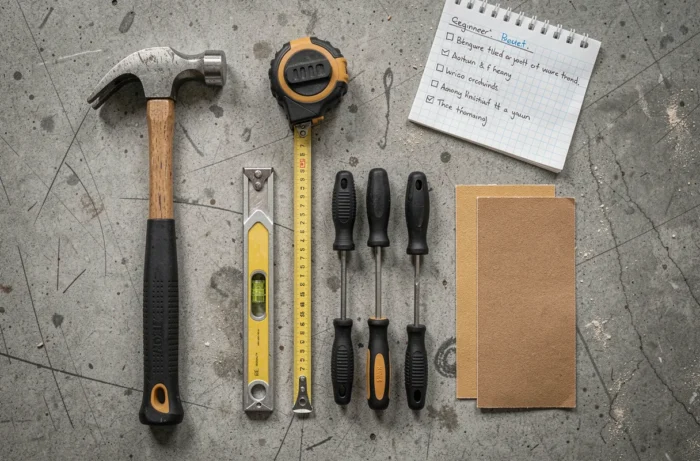
Have you ever noticed that one screwdriver is never enough? A set of flat and Phillips screwdrivers (at least four sizes) prevents forcing an ill-fitting screw and damaging the drive. Choose ergonomic handles with a non-slip coating: a good grip makes all the difference when working overhead.
The hammer comes next. A model with a head weighing around 300 g is suitable for most household uses: driving a nail into wood, adjusting an assembly, removing a small nail with the integrated claw. If it’s too light, it requires harder and less precise strikes. If it’s too heavy, it tires the wrist in just a few minutes.
The list is completed with three other tools found in the essential tools from Univers du Bricolage that deserve a place in any toolbox:
- A slip joint pliers, capable of tightening a nut, holding a pipe, or bending a wire. Opt for a model with adjustable jaws and serrated grips.
- A tape measure of at least three meters, with a reliable locking mechanism. Measuring before cutting is the golden rule of DIY, and an inaccurate or too short tape complicates every project.
- A spirit level of 40 to 60 cm. Installing a shelf crookedly is immediately noticeable, and correcting it afterward takes three times longer than checking before drilling.

Cordless drill and saw: when electric tools become necessary
To drill a concrete wall or screw in thirty screws into a flat-pack piece of furniture, wrist strength is no longer sufficient. The cordless drill-driver is the first electric tool to acquire. It replaces the screwdriver for repetitive tasks and drills through most common materials (wood, plaster, hollow brick).
Why cordless instead of corded? The freedom of movement, especially in a home where outlets are rarely where you need them. However, the choice of battery deserves attention.
Batteries: a selection criterion that classic lists overlook
Regulation (EU) 2023/1542, applicable from February 18, 2024, governs the lifecycle of batteries integrated into power tools: safety, labeling, collection, and recycling. From February 18, 2027, portable batteries must be user-replaceable with commonly available tools.
For a beginner, the consequence is direct: avoid drills with non-replaceable proprietary batteries. Prefer a brand that offers a battery platform common to several tools (drill, saw, sander). When the battery wears out, you replace it instead of discarding the machine.
The saw: which model to start with
A universal tooth hand saw cuts wood, PVC, and some particle boards. It is inexpensive and requires no energy. For longer or more frequent cuts, an electric jigsaw takes over. It accepts different blades depending on the material (wood, thin metal, plastic), making it a versatile tool without taking up too much space.
Protecting your eyes and hands before starting work
A slipping hammer, a drill that throws plaster dust, a slipping utility knife: household accidents related to DIY are common, often due to negligence regarding safety gear.
- Wrap-around safety glasses, not just regular sunglasses. They also protect the sides, where debris can come from.
- A fitted pair of work gloves. If they are too large, they reduce precision. If they are too thick, they prevent feeling the piece. A model made of reinforced synthetic leather at the palms offers a good compromise.
- A retractable blade utility knife, stored with the blade retracted. This small tool cuts cardboard, carpet, seals, and plastic films, but it is responsible for many cuts when the blade is left exposed in the toolbox.
Storing each tool in its place after use also reduces risks. A compartmentalized toolbox or a perforated wall panel keeps blades and points out of children’s reach.
Right to repair and durability: choosing tools that last
Buying cheap to “see if DIY is enjoyable” seems logical. The problem is that a screwdriver whose tip dulls after three uses discourages faster than it saves money.
The directive (EU) 2024/1799 on the right to repair, applicable by member states from July 31, 2026, pushes manufacturers to provide spare parts and repair information for several categories of goods.
For a beginner, two reflexes are worth adopting from the start. Check that the manufacturer offers spare parts (motor brushes, chuck, switch). Also, see if the brand is part of a battery take-back or recycling program, in accordance with the European battery regulation.
A good starter toolkit fits into a single box: five hand tools, a drill-driver, a saw, safety gear, and a utility knife. It’s better to have six quality tools than fifteen fragile gadgets. The first successful project, even modest, gives the momentum to move on to the next one.