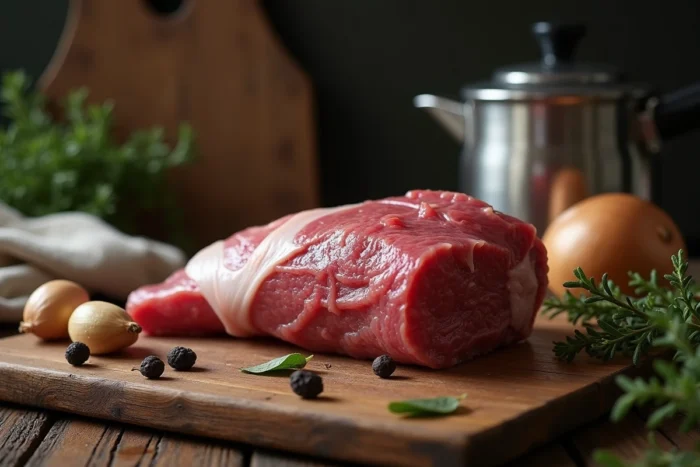
Beef tongue cooked in a pressure cooker remains a beloved family dish, but achieving the perfect result requires mastering a few parameters that classic recipes rarely mention. Cooking time varies depending on the weight of the piece, the heat intensity, and even the age of the animal. Sticking to a fixed duration without other benchmarks can lead to rubbery or, conversely, stringy meat.
Internal temperature: the benchmark that beef tongue recipes ignore
Most French recipes rely on a knife test to check for doneness. The blade should slide in without resistance into the thickest part. This criterion remains subjective: the result changes depending on who is holding the knife.
A probe thermometer offers much more reliable control. Recent technical sources consider beef tongue cooked and tender when the thickest part reaches 85 to 95 °C at the core. This objective benchmark allows one to bypass indicative durations, which vary from one pot to another and from one heat source to another.
An instant-read probe thermometer costs just a few euros and fits easily in a drawer. For cooking beef tongue in a pressure cooker, it transforms a rough estimate into a measurable data point. Insert the probe into the center of the tongue after decompression, and adjust the time if the temperature is not reached.
Adjusting cooking time based on the weight of the tongue
Popular recipes often announce a single cooking time, without considering the actual weight of the piece. A beef tongue can weigh anywhere from less than one kilogram to nearly two kilograms. Applying the same duration to these two extremes yields very different results.
The most reliable approach is to reason by kilogram. A heavier tongue logically requires a longer cooking time under pressure. Field feedback varies on this point: some pots reach pressure faster, and some tongues come from older animals whose meat is firmer.
Combining duration per kilogram and probe verification remains the safest method. Start with a base time proportional to the weight, then check the internal temperature after decompression. If the meat is not tender enough, a few more minutes under pressure will suffice.
Blanching the tongue before pressure cooking: why and how
Plunging the tongue into cold water, bringing it to a boil, and then discarding this first water constitutes the blanching step. It removes impurities and reduces the strong odor that the meat emits during cooking.
Some recipes suggest soaking the tongue in vinegar water for several hours instead. Both methods aim for the same goal, but blanching by boiling acts faster and is better suited to the rhythm of pressure cooking. Here are the concrete steps:
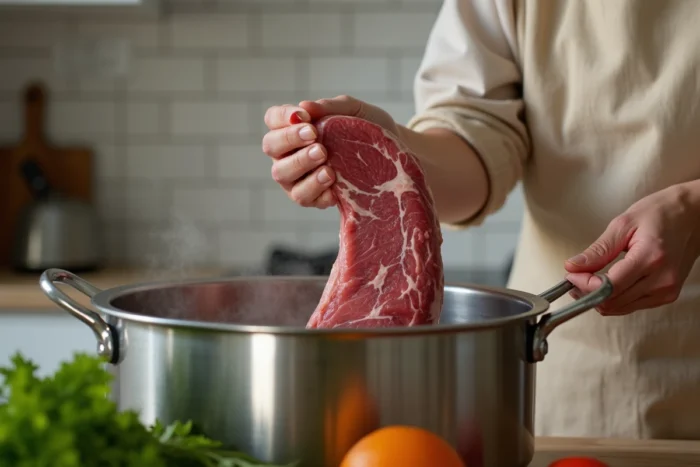
- Rinse the tongue under cold water, place it in the pot covered with water without sealing the pressure lid
- Bring to a boil over high heat, let boil for two to three minutes, then drain and rinse the tongue
- Empty and clean the pot before starting the actual cooking, to eliminate any scum residues
Never skip this step: pressure cooking concentrates flavors, including undesirable ones. A cloudy and bitter broth ruins the entire dish.
The aromatic broth and cooking in a pressure cooker
Beef tongue cooks in a liquid, and the quality of this broth largely determines the final taste of the meat. A minimal court-bouillon (water, salt) yields bland meat. A well-composed broth deeply flavors the tongue, as the pressure cooker maintains close contact between the meat and the liquid under pressure.
Classic aromatic elements work well:
- An onion studded with cloves, a few peppercorns, a bay leaf
- Carrots and celery for a vegetable base that softens the broth
- A cube of vegetable or beef broth to enhance flavor if the tongue is small and the liquid abundant
- Coarse salt, added from the start so that the meat absorbs the seasoning throughout the cooking time
Cover the tongue with water just to the level, without drowning it. Too much liquid dilutes the aromas. The pressure cooker does not require as much water as a traditional pot since evaporation is nearly nonexistent.
Peeling the beef tongue: the technical gesture not to miss
The skin of the tongue must be removed after cooking. If the cooking is sufficient, this thick and rough skin easily detaches when pulled with fingers, possibly aided by a small knife.
A common pitfall: waiting too long after removing it from the pot. The skin comes off much more easily when the tongue is still warm. A cooled tongue complicates the operation, as the membrane adheres to the meat and tears into small pieces.
Remove the tongue from the broth, rinse it briefly under warm water to handle it, then peel starting from the tip towards the base. The thicker back part sometimes requires a knife to initiate the removal. If some areas resist, the tongue is probably not cooked enough: put it back under pressure for a few minutes.
Spicy sauce, gribiche, or madeira: what accompaniment for the tongue
Beef tongue is rarely served alone. Its delicate yet subtle flavor calls for a sauce that structures the dish. Three classics dominate French cuisine in this area.
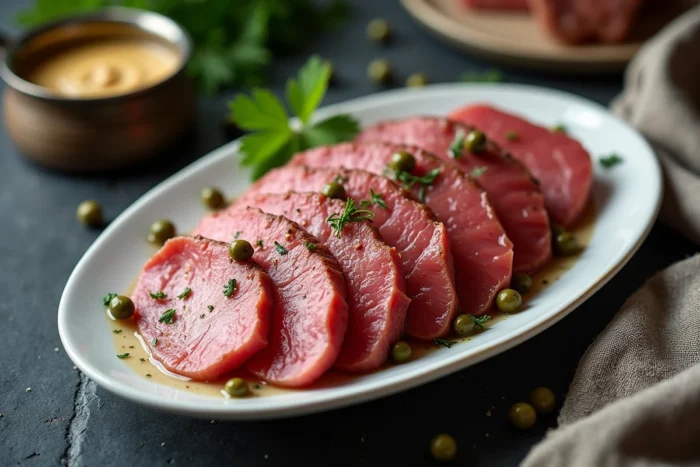
The spicy sauce, made with vinegar, shallots, and pickles, provides the acidity that contrasts with the tenderness of the meat. The cold gribiche sauce, made with hard-boiled eggs, capers, and pickles, is better suited for summer or as a starter. The madeira sauce, richer, envelops the tongue in a hearty jus that appeals to lovers of generous dishes.
The filtered cooking broth serves as the base for each of these sauces. Reducing part of the broth after removing the tongue concentrates the flavors and creates a sauce base without extra effort. A few steamed potatoes or a purée complete the plate without competing with the sauce.
The choice of sauce mainly depends on the season and the rest of the meal. A tongue served as a standalone dish can support a rich madeira sauce. In a complete menu, gribiche or spicy sauce lightens the overall dish.