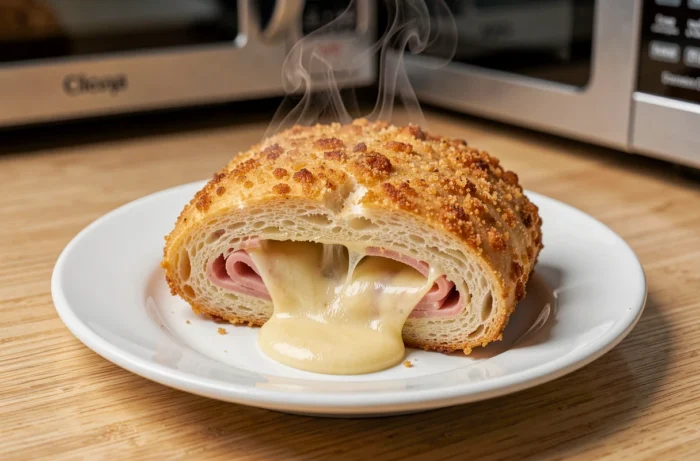
The microwave cordon bleu presents a physics problem before it becomes a recipe question. Microwaves stir the water molecules present in the meat, cheese, and coating, generating steam inside the breadcrumb itself. The result: a moisture-saturated shell, impossible to make crispy with this cooking method alone. Understanding this mechanism allows one to adapt their technique rather than suffer a soggy result.
Steam and Coating: Why the Microwave Alone Softens the Cordon Bleu
Classic breadcrumbs, made from dried and crushed bread, derive their crispiness from a Maillard reaction achieved through dry heat (oven, pan, frying). The microwave does not produce dry heat. It heats the water contained in the food, and this water migrates to the surface in the form of steam.
The coating then absorbs this steam like a sponge. The longer the cordon bleu stays in the microwave, the more the breadcrumbs become soggy. The microwave heats the center but destroys the surface texture.
The cheese exacerbates the phenomenon. As it melts, it releases whey (the watery part of milk) that rises through the meat. If the cordon bleu is not stabilized by resting after cooking, the cheese leaks out from the edges and further soaks the coating.
For those wishing to cook a cordon bleu in the microwave with an acceptable result, the only realistic approach is to limit the cooking time and finish the cooking on a dry heat source.
Power Setting and Microwave Cooking Time
The ideal power is around 900 W for a standard-sized cordon bleu. At this power, the center reaches a sufficient temperature in about one minute, without the coating having time to become completely soaked.
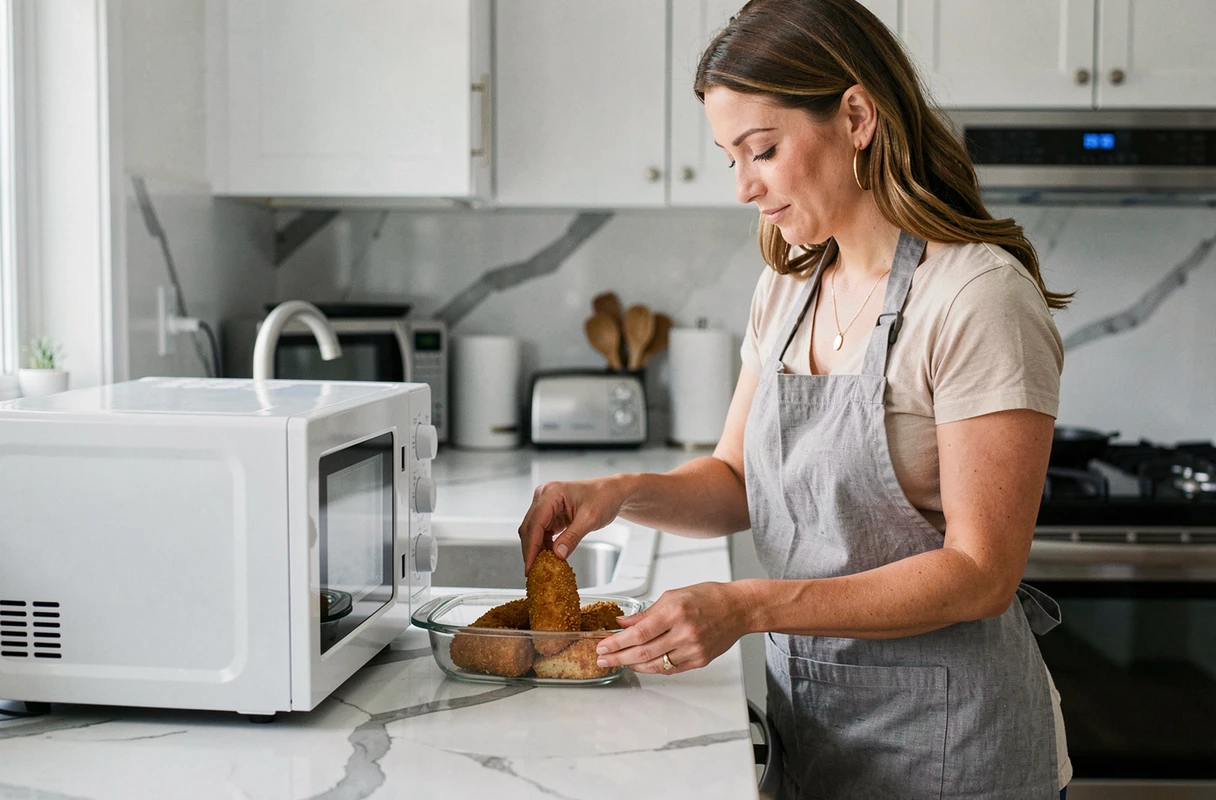
Reducing the power to 600 or 700 W extends the cooking time and increases exposure to steam. The result is paradoxically worse than at full power, as the breadcrumbs remain longer in a humid environment.
Two technical precautions during cooking:
- Place the cordon bleu on absorbent paper, which captures some of the moisture released from the base (the part in contact with the plate always softens first)
- Never cover with an airtight lid or plastic wrap, which trap steam and accelerate the softening of the coating
- For a frozen cordon bleu, do not exceed the time indicated on the manufacturer’s packaging, as some brands explicitly advise against using the microwave for their products
The microwave cooking does not constitute complete cooking. It serves to heat the center (meat and cheese) to then reduce the finishing time.
Finishing in a Pan, Oven, or Air Fryer: Texture Comparison
The two-step method (microwave followed by dry finishing) is the only one that allows for a combination of speed and acceptable texture. We recommend choosing the finishing method based on the available equipment and the desired result.
Pan with a Drizzle of Fat
After one minute in the microwave, two minutes per side in a medium heat pan is sufficient. The pan provides the best browning in a total time of about five minutes. A drizzle of neutral oil (sunflower, peanut) or a knob of clarified butter improves the thermal contact between the coating and the cooking surface.
The trap: flipping too early. The breadcrumbs need time to dry and brown before being moved, or they risk coming off.
Preheated Oven for Multiple Portions
If you are preparing multiple cordon bleus, a stint in a convection oven after the microwave yields a more uniform result than in a pan. Allow a few extra minutes compared to the pan. The convection heat dries the surface on both sides simultaneously, which avoids having to flip each piece.
Air Fryer for Maximum Crispiness
The air fryer concentrates a flow of hot air on the coating. The texture achieved is similar to that of frying without the addition of fat. We find that this finishing method provides the best crispiness among the three options, with a short cooking time after microwaving.
Resting After Cooking: The Detail That Prevents Cheese Leaks
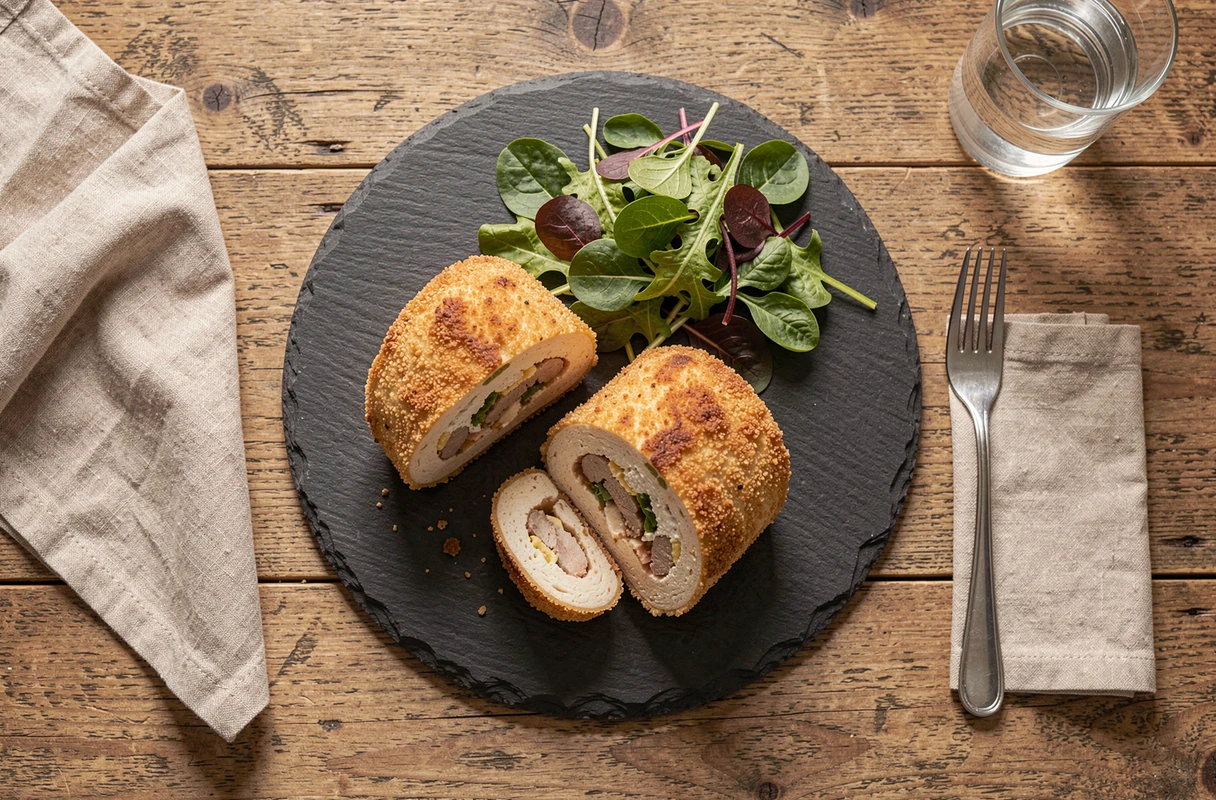
A cordon bleu served immediately after cooking loses its cheese with the first cut. Resting for one to two minutes stabilizes the melted cheese and allows the coating to firm up slightly on the surface.
This resting time is not perfectionism. Melted cheese is a fluid that flows under the effect of gravity and internal pressure. By cooling down a few degrees, it thickens and stays inside the meat envelope.
During the resting period, place the cordon bleu on a rack rather than on a flat plate. Direct contact with a cold surface creates condensation under the base, which softens the lower coating again.
Frozen or Fresh Cordon Bleu: Adapting the Technique
An industrial frozen cordon bleu (Maître Coq, Père Dodu, or equivalent private label) has a coating formulated to withstand various cooking conditions. The breadcrumbs are often pre-fried in the factory, giving them a base of crispiness that is more resistant to microwave moisture.
A homemade cordon bleu has a more fragile coating as it has not undergone pre-frying. The microwave cooking should be even shorter, and the pan finishing slightly longer to compensate.
Some brands offer frozen cordon bleus designed for direct cooking without prior thawing. Maître Coq specifies this for its frozen chicken cordon bleu. In this case, the microwave can serve as a quick defrosting step before finishing, following the manufacturer’s instructions.
The microwave remains a quick tool for heating the center, not a substitute for dry cooking. Accepting this limitation and integrating it into a two-step method transforms a mediocre fix into a decent meal in just a few minutes.