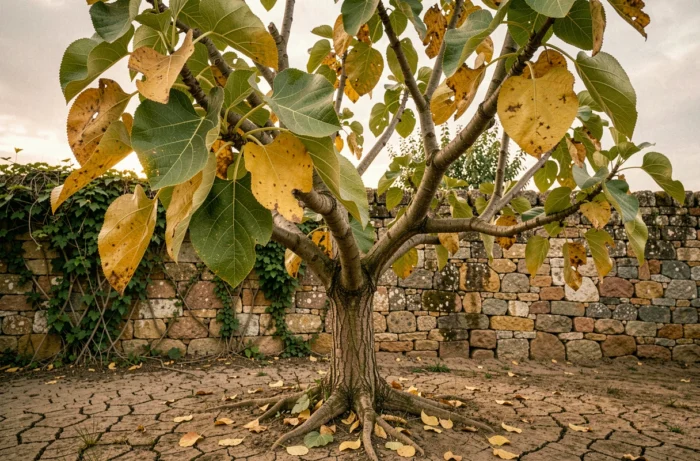
When a fig tree loses its leaves in the middle of summer, the first instinct is often to water more or to treat for a disease. However, the yellowing of fig leaves covers very different situations, from simple water stress to a nutrient deficiency, including a fungal attack. Distinguishing these causes before taking action helps avoid worsening the problem.
Visual Diagnosis of the Fig Tree: Symptoms Table by Cause
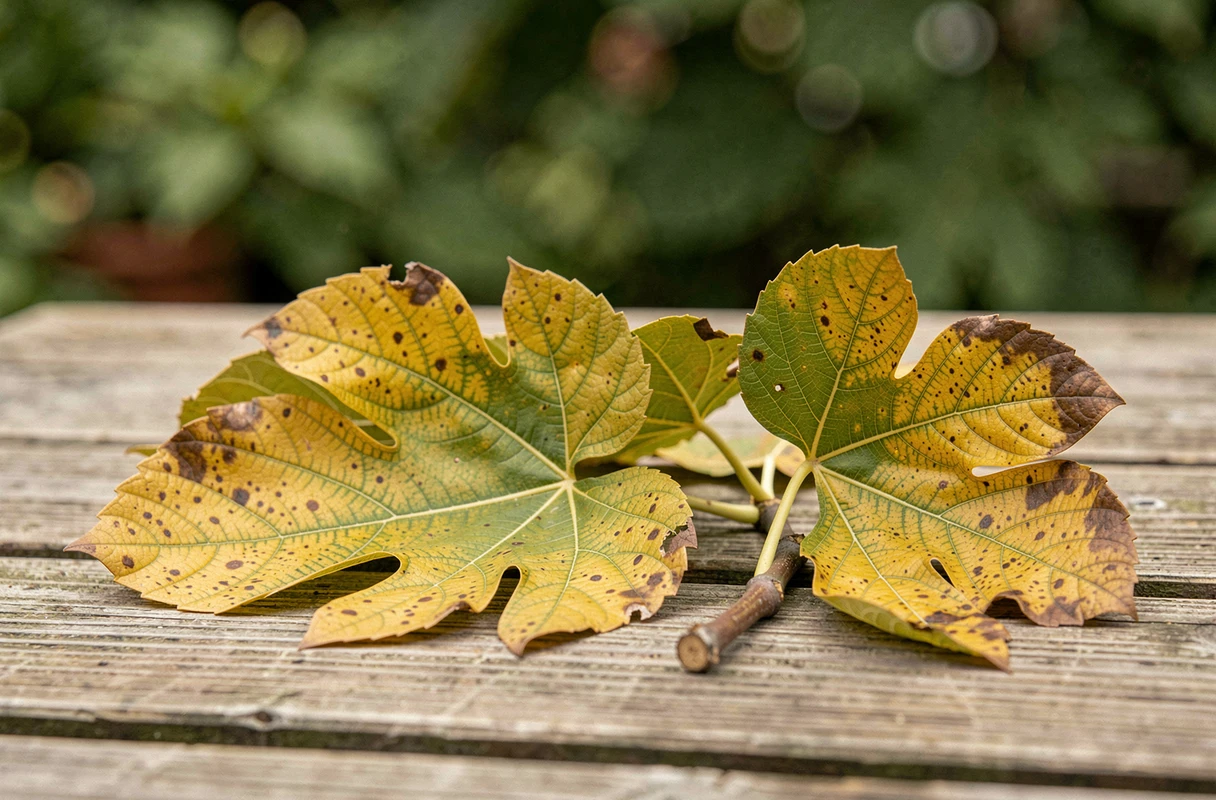
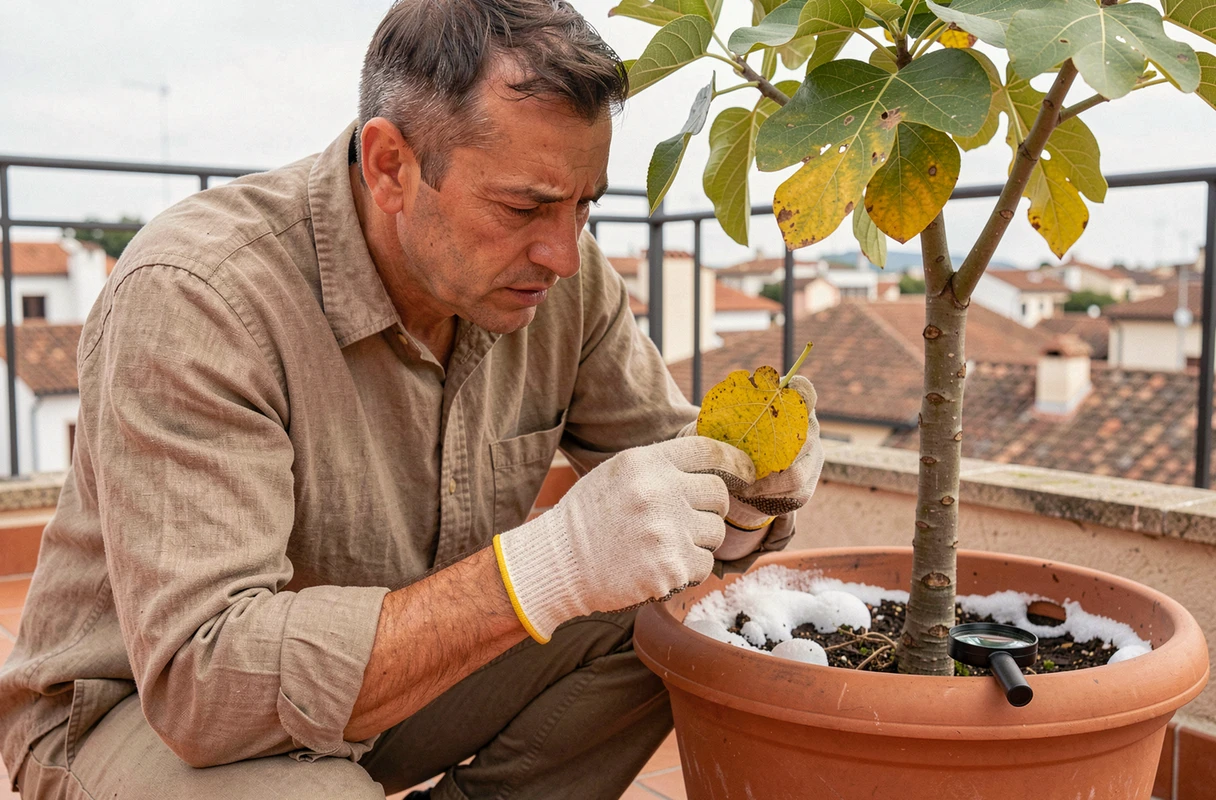
The first useful step is to closely observe the leaf. The shape of the yellowing, the presence or absence of spots, and the texture of the blade guide the diagnosis much more reliably than a randomly applied treatment.
| Observed Symptom | Probable Cause | Additional Clue |
|---|---|---|
| Uniform yellowing, soft leaves without spots | Water stress (lack or excess of water) | Dry soil at depth or, conversely, waterlogged |
| Orange or brown spots, sometimes powdery | Fungal disease (fig rust) | Underside of the leaf spotted, humid weather |
| Yellowing between the veins, veins remaining green | Iron chlorosis (iron deficiency) | Calcareous or compact soil, high pH |
| Leaves that yellow and fall massively in summer | Summer shedding (natural mechanism) | The tree reduces its leaf area to adapt to the heat |
| Yellowing after soil or lawn treatment | Contact with a herbicide | Shallow root system affected by root absorption |
This table highlights a point that many gardeners overlook: uniform yellowing without spots is generally not a disease. Confusing water stress with fungal infection leads to unnecessarily spraying a fungicide on a tree that simply needs appropriate watering.
When fig leaves yellow and fall after applying a herbicide nearby, the diagnosis often takes longer because the symptoms resemble a lack of water.
Water Stress in Fig Trees: Too Much or Not Enough Water
The vast majority of cases of summer yellowing are due to a water imbalance. The fig tree is a Mediterranean tree capable of withstanding drought, but it does so by sacrificing its foliage. This is known as summer shedding, a normal regulation mechanism.
The tree voluntarily reduces its leaf area to limit evapotranspiration when the soil no longer offers enough water. This behavior does not mean it is sick. Rather, it indicates that the soil’s water reserve is insufficient to maintain the entire foliage.
Deep and Spaced Watering Rather Than Frequent and Shallow
The most common mistake is to multiply small daily waterings. A drip system must run for several hours to be effective on a fig tree, as the soil needs to be moistened deeply. Shallow watering wets the top few centimeters without reaching the deep roots.
- Deep spaced watering: a substantial supply every seven to ten days in summer, allowing the water to penetrate slowly into previously loosened soil
- Thick mulch at the base of the trunk (at least ten centimeters of organic matter) to limit evaporation and maintain soil freshness
- Checking moisture at twenty centimeters deep before watering: if the soil is still cool, there is no need to add water
- Loose and well-drained soil so that water does not stagnate at the roots, which would cause root rot with similar yellowing
Excess water produces symptoms similar to a lack of water, making the trap formidable. A potted fig tree in poorly drained substrate yellows exactly like a thirsty fig tree in the ground. The difference is verified by touching the substrate: a waterlogged soil and a dry soil do not feel the same.
Nitrogen Fertilizer in Summer: The Gesture That Worsens Yellowing
Faced with yellow leaves, some gardeners think to stimulate their fig tree with a nitrogen-rich fertilizer. This reaction seems logical, as nitrogen promotes leaf growth and chlorophyll.
The problem arises when this input occurs during a heatwave. A nitrogen fertilizer during high heat stimulates leaf growth while the tree is trying to slow it down. The fig tree attempts to reduce its evaporation surface, and nitrogen pushes it to produce new leaves that it cannot hydrate. The yellowing accelerates instead of correcting.
Fertilization Suitable for the Fig Tree’s Cycle
The ideal time to fertilize a fig tree is in early spring, when vegetative recovery begins and the soil’s water reserves are still sufficient. An application of well-decomposed compost in autumn also prepares the soil for the next season without forcing growth at the wrong time.
If yellowing occurs in July or August, it is better to correct the watering and mulch generously rather than add a fertilizer. The tree does not need extra food; it needs its roots to access water.
Rust and Fungal Diseases of the Fig Tree: Recognizing a True Infection
Fig rust (Cerotelium fici) is recognized by orange to brown spots on the underside of the leaves, sometimes accompanied by a powdery appearance. Affected leaves yellow and then fall, but the visual pattern differs markedly from water stress.
Localized necrotic spots on the blade signal a fungal attack, not a watering problem. Rust develops mainly in warm and humid weather when the foliage remains wet for long periods.
- Collect and destroy fallen leaves to limit the spread of spores on the ground
- Avoid watering the foliage, directing water only at the base of the tree
- Air the branches through reasonable pruning at the end of winter, to reduce stagnant humidity between branches
A preventive treatment based on Bordeaux mixture may be justified in early spring, before the appearance of symptoms. Applied once the spots are visible, its effectiveness remains limited as the spores have already colonized the leaf tissues.
The difference between a stressed fig tree and a sick fig tree often comes down to a careful examination of the leaf. Uniform yellowing without spots points to water, localized lesions point to a fungus. This simple distinction avoids most treatment errors and allows for action on the correct cause at the first signs.