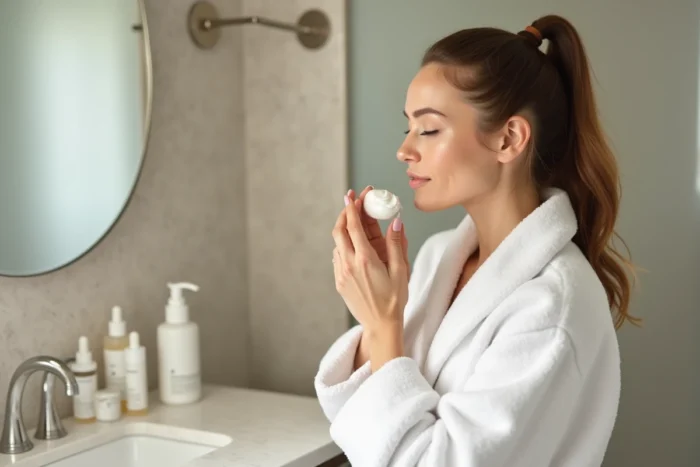
We buy a serum because a friend speaks highly of it, we layer three creams in the morning without really knowing what each one does, and after two months we see no change. The problem rarely lies with the products themselves. It comes from the order in which we apply them, the number of steps we impose on ourselves, and the consistency between what we put on our skin and what it actually needs.
Fewer steps, more results: the streamlined beauty routine
FEVAD notes that the average number of hygiene-beauty occasions per week has decreased from 51.4 in 2013 to 42.6 in 2025. We use fewer products, but we choose them better. This shift is not a passing trend.
In practice, an effective morning skincare routine consists of three steps: a gentle cleanser, a moisturizing treatment suited to your skin type, and sun protection. In the evening, we replace the sun protection with a targeted treatment (serum or night cream). Nothing more, unless a specific need is identified.
Reducing the number of products decreases the risk of cross-reactions between active ingredients. This is particularly true when mixing exfoliating acids with retinol, a combination that irritates sensitive skin without providing additional benefits. Several technical sheets available on cosmetiques-beaute.net allow you to check the compatibility of actives before composing your routine.

Daily sun protection: the most underestimated care
More and more dermatologists recommend applying sun protection every day, even in winter or on cloudy days. UV rays penetrate clouds and bounce off light surfaces. We think we are protected by staying indoors, but UVA rays pass through windows.
On the ground, the main barrier remains the texture. A sunscreen that leaves a greasy film or a white cast ends up in the drawer after a week. Choosing a lightweight textured SPF that you can tolerate every day is better than a SPF 50 that you never apply.
How to integrate SPF without weighing down the routine
Two options work well on a daily basis:
- A moisturizer with integrated sun filter, which replaces the day cream and sunscreen in one step. It saves time and reduces the thickness on the skin.
- A transparent solar spray applied as the last step, over makeup. It allows for reapplication of protection in the middle of the day without starting over.
- A mineral powder with SPF, practical for touch-ups for combination skin that shines by late morning.
The idea is not to add a product, but to replace an existing product with an equivalent that also protects against UVs.
Choosing facial care by ingredients rather than by brand
Recent market analyses show that purchasing decisions are now more guided by effectiveness and ingredients than by brand reputation. We read labels like we read a shopping list: what matters is what’s inside.
In practice, identifying two or three actives suited to your main concern is enough to filter products in-store or online. For dehydrated skin, we look for hyaluronic acid and glycerin. For enlarged pores and dull complexion, niacinamide provides visible results in a few weeks.
Cosmetic actives: effective combinations
We don’t need ten actives. We need the right ones, used at the right time.
- Vitamin C in the morning combined with sun protection: it enhances the anti-UV action and brightens the complexion.
- Hyaluronic acid combined with an occlusive cream in the evening: hyaluronic acid captures water, the cream prevents its evaporation overnight.
- Niacinamide and zinc for oily-prone skin: this duo regulates sebum without drying.
- Retinol alone, in the evening, on clean, dry skin: avoid combining it with exfoliating acids to limit irritation.
Feedback varies on the effectiveness of certain actives depending on skin types, but this foundation covers the majority of common needs without multiplying layers.

Soap, milk, cleansing gel: which cleanser for which use
Cleaning remains the step where we make the most mistakes. A classic soap with a high pH damages the hydrolipidic film. A makeup remover milk that is too rich leaves a residue on combination skin. The cleanser must match the oiliness and sensitivity of your skin, not a current trend.
For normal to combination skin, a soap-free cleansing gel does the job morning and night. On dry or reactive skin, a milk or oil cleanser followed by rinsing with lukewarm water better preserves skin comfort. Oily skin can tolerate a foaming cleanser, provided it is not used more than twice a day.
Double cleansing: useful or unnecessary
Double cleansing (oil then gel) makes sense in the evening when wearing makeup or sunscreen. The oily phase dissolves UV filters and pigments, the aqueous cleanser removes residues. In the morning, a single pass with a gentle cleanser is sufficient. Cleansing twice on skin that is not made up is unnecessary stripping.
Adapting the frequency and intensity of cleansing to what is actually on the skin, day by day, avoids rebound effects (skin that overproduces sebum to compensate for excessive stripping). The most effective beauty routine is one that remains stable over time, with products that we actually use because they suit our skin and our rhythm.