
Recognizing a genuine Cabaia bag is not solely based on the product’s exterior appearance. The brand has implemented an internal identification system that links each bag to a verifiable customer journey. This mechanism distinguishes an authentic bag from a well-made copy, even when the visual finishes seem correct at first glance.
Internal label and Cabaia identification code: the decisive test
The most reliable checkpoint on a Cabaia bag is a label sewn inside, bearing a unique identification code. This code is not just a decorative serial number. It allows the product to be registered in the brand’s official tool and activates the warranty.
A counterfeit may replicate the appearance of this label. However, the code it carries will consistently fail during the registration attempt on the Cabaia platform. This is the difference between a copied visual element and a functional element linked to a database.
| Criterion | Authentic Cabaia Bag | Common Counterfeit |
|---|---|---|
| Internal label | Sewn, readable code, clear typography | Glued or absent, blurry or non-existent code |
| Online registration | Code accepted by the official tool | Code rejected or unrecognized |
| Activatable warranty | Yes, with proof of purchase | No |
| Internal seams | Regular, strong threads, no excess | Irregular, threads sticking out |
| Zippers | Fluid sliding, engraved pull tab | Resistance to sliding, generic pull tab |
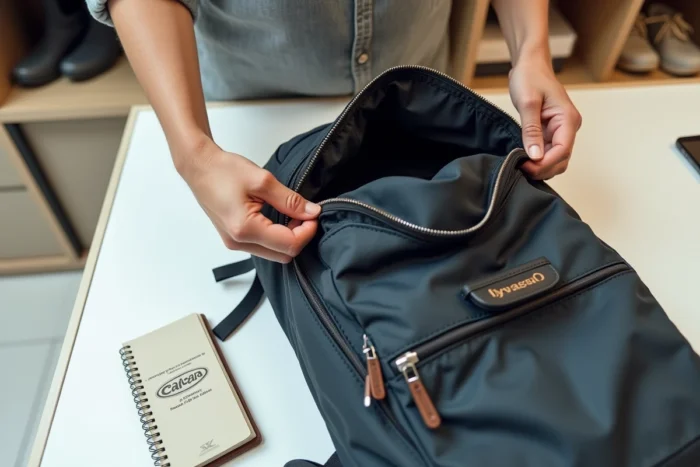
To find out how to obtain the Cabaia authentication code, you need to open the main compartment and locate the label sewn into the lining. This code is the only data that physically links your bag to the brand’s traceability system.
Material quality and stitching: what copies miss
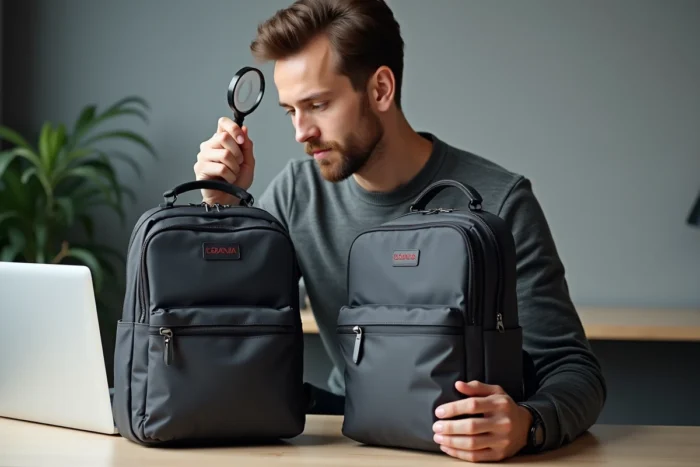
Visual inspection remains useful, provided you know where to look. Counterfeiters replicate the exterior patterns and colors quite well. The discrepancies focus on less visible manufacturing details.
Fabric and lining
The fabric of an authentic Cabaia bag has a consistent density to the touch. Copies often use a thinner fabric, sometimes slightly plasticized, which wrinkles differently. The inner lining of a genuine bag shows a uniform weave without translucent areas.
Stitching finishes
The stitching is the best physical indicator after the identification code. On an authentic bag, the topstitching follows a straight line with a consistent spacing between the stitches. The stitches of a fake show visible irregularities: crossing threads, varying stitch sizes, excess thread at junctions.
- Check the stitching at the corners of the bag, where the fabric tension is highest: this is the first place to give way on a copy
- Examine the base of the bag, often reinforced on an authentic model by a double stitch, absent on counterfeits
- Gently pull on the straps at the attachment point: an authentic Cabaia bag shows no play, while a copy may reveal a fragile assembly
Buying on a marketplace: check the seller before the product
An increasing share of Cabaia counterfeits circulates on peer-to-peer resale platforms. Buyer feedback on social media shows that the most deceptive copies arrive via discounted listings on these marketplaces.
Before even examining the bag, three elements of the purchasing journey deserve attention.
- The displayed price: a Cabaia bag sold significantly below the usual price, even second-hand, signals a high risk
- The proof of purchase: a legitimate seller can provide a receipt or order confirmation. Counterfeiters never have these documents
- Photos of the internal label: always request a photo of the identification code before purchase. If the seller refuses or sends a blurry image, move on
The Cabaia brand explicitly distinguishes the identification code from the product registration. An authentic bag must be able to be registered in the official tool. If the seller claims the bag is authentic but the code does not work during registration, the product is a counterfeit, regardless of its exterior appearance.
Cabaia packaging and accessories: often overlooked clues
Buyers focus on the bag itself and forget to examine what accompanies it. Feedback published by consumers who received copies shows that discrepancies in the packaging are often more glaring than on the product.
An authentic Cabaia bag arrives with packaging that has sharp print quality, without color smudges or text misalignment. Counterfeits frequently display spelling errors on the outer labels or slightly distorted logos.
The interchangeable pockets, a characteristic accessory of the brand, also offer a checkpoint. On an authentic model, the pocket attachment system snaps into place without forcing. On a copy, the mechanism jams or has play.
What to do after receiving a suspicious bag
If the code registration fails, keep the bag, its packaging, and any proof of purchase. Contact Cabaia customer service providing these elements. The brand can confirm whether the code corresponds to a product from its production.
On resale platforms, most offer a dispute procedure. Report the counterfeit to the seller and the platform by attaching screenshots of the registration failure. This document constitutes the strongest proof, far more than a visual assessment of the materials.
The only check that definitively distinguishes a genuine Cabaia bag from a copy remains the registration of the identification code in the official tool. Visual checks (stitching, fabric, packaging) can help spot gross copies, but against a well-made counterfeit, only the digital validation of the code holds true.