
The shelf life of vacuum-sealed food depends on variables that classic tables oversimplify. Actual refrigerator temperature, freshness at the time of packaging, product type: each parameter alters the final result. Comparing the stated durations to the necessary conditions to achieve them allows for better use of this preservation technique.
Refrigerator Temperature and Vacuum Preservation: The +3 °C Threshold
Most of the vacuum preservation durations published online are based on an assumption rarely specified: the refrigerator must be set to +3 °C or lower. An average household appliance typically ranges from +4 °C to +7 °C depending on the zone and the frequency of door openings.
At +5 °C, bacterial proliferation slows down but does not stop at the same rate as at +2 °C. A two-degree difference can significantly reduce the actual shelf life compared to the theoretical figures displayed in a generic table.
Before relying on a vacuum food preservation table, checking the actual temperature of your refrigerator with an independent thermometer remains the most useful action. Without this measurement, the durations remain optimistic estimates.
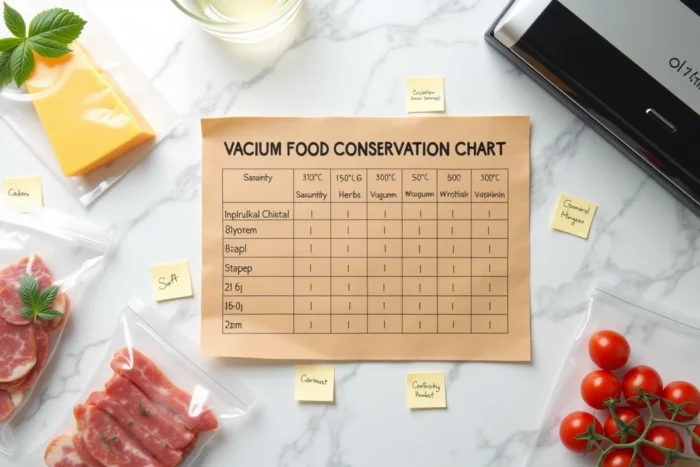
Vacuum Preservation Durations in the Refrigerator: Comparative Table
The data below compile the average accepted durations for proper vacuum sealing, stored at +3 °C or lower. The “without vacuum sealing” column corresponds to conventional refrigeration in a regular container.
| Food | Without Vacuum Sealing | Vacuum Sealed (Refrigerator at +3 °C) | Approximate Ratio |
|---|---|---|---|
| Raw Meat | 2 to 3 days | About 1 week | x3 to x4 |
| Cooked Meat | 3 to 4 days | 10 to 12 days | x3 |
| Fresh Fish | 1 to 2 days | 4 to 5 days | x3 |
| Smoked Fish | About 5 days | About 2 weeks | x3 |
| Raw Vegetables | 4 to 7 days | 1 to 3 weeks | x3 to x5 |
| Hard Cheese | 2 to 3 weeks | 1 to 2 months | x3 to x4 |
| Fresh Fruits | 3 to 7 days | 2 to 3 weeks | x3 to x5 |
The x3 to x5 ratio appears for every category, providing a reliable mental benchmark. Multiplying the usual duration by three constitutes a cautious estimate, while five is a high estimate valid only under optimal temperature and initial freshness conditions.
Why Vegetables and Fruits Show a Wider Range
The “1 to 3 weeks” range for raw vegetables is explained by the diversity within this category. A firm bell pepper packaged on the day of harvest does not behave like a leafy salad picked two days ago.
Fragile products like salads or soft fruits do not withstand the pressure of standard vacuum sealing well. Modified Atmosphere Packaging (M.A.P.), which replaces air with a neutral gas without crushing the product, better preserves their texture. A standard vacuum bag can alter the appearance and firmness of these foods, even if the shelf life increases.
Initial Freshness of the Product: The Factor Ignored by Tables
A food item already close to its freshness limit at the time of vacuum sealing will not miraculously gain an additional week. Vacuum sealing freezes the state of the product; it does not restore it.
Two identical pieces of meat, one packaged on the day of purchase and the other two days later, will show very different vacuum preservation durations. The table cannot reflect this variable, which explains the discrepancies between actual experience and published figures.
- Package the product as soon as possible after purchase or preparation, ideally on the same day.
- Visually and olfactorily check the food before vacuum sealing: any existing alteration will continue to develop, even at a slower pace.
- For cooked meats and prepared dishes, cool quickly before packaging to avoid condensation inside the bag.
Perishable Products Beyond 10 Days: The Regulatory Limit
For food service professionals, extending the vacuum preservation duration beyond ten days for highly perishable products (raw meat, fresh fish) involves an additional constraint. A documented validation of the time/temperature pair may be required by health authorities as part of the food safety management plan.
In practice, this means that the long durations displayed in some tables are not directly applicable in commercial food service without associated aging studies or HACCP protocols. An individual does not face this obligation, but the principle remains relevant: beyond 10 days, the safety margin decreases, and the rigor regarding storage temperature becomes crucial.
Vacuum Sealing and Freezing: Two Complementary Techniques
For preservation durations exceeding two weeks, combining vacuum sealing and freezing remains the most reliable solution. Vacuum sealing limits freezer burn and protects the organoleptic qualities of the product for several months.
Vacuum freezing is particularly suitable for raw meats and batch-cooked dishes. Raw vegetables, on the other hand, often require prior blanching to maintain their texture after thawing.
The most useful preservation table is not the one that displays the longest durations, but the one that specifies its validity conditions. A duration without mentioning the storage temperature or the initial state of the product remains a theoretical figure. Measuring the actual temperature of your refrigerator and packaging products as soon as they are purchased transforms these estimates into concrete results.