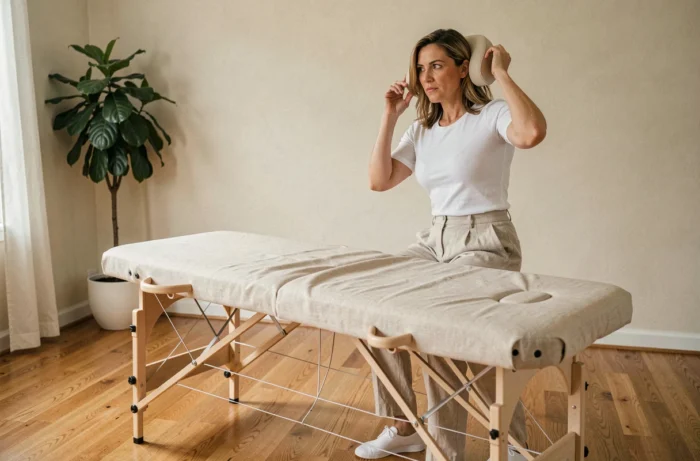
A physiotherapist friend regularly massages his partner on their bed, due to a lack of space for dedicated equipment. The result: back pain for him, discomfort for her, and shortened sessions. The day he set up a folding table in their living room, the quality of the massages changed completely.
Choosing a massage table for home use is not just about ticking boxes on a product sheet. It’s about solving an equation between the available space, the comfort of the receiver, and the postural health of the person doing the massage.
Repairability and spare parts: the criterion that no one considers before purchase
People often start by comparing prices, dimensions, and weight. But the question that makes a difference in the long run is this: when an adjustment cable breaks or the covering cracks, can you order the part?
A technical guide from 2026 (MFB Provence) explicitly recommends checking the availability of spare parts and repairability before any purchase. For a table used at home, we’re talking about several years of use. Foam that collapses after two years or a headrest with a broken locking system can happen. If the manufacturer does not offer replacement parts, the entire table becomes waste.
Specifically, before confirming an order, we check three things: does the manufacturer sell replacement covers and foams? Is the folding or height adjustment mechanism repairable? Is there a customer service available in France? The catalogs available on latable-de-massage.fr allow for comparison of these points across several ranges, which prevents being stuck after a few months of use.
Folding massage table at home: width and height above all
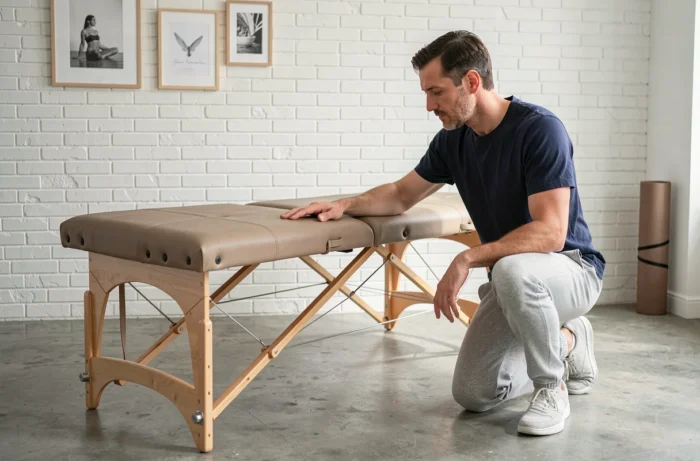
Most guides detail the choice between wood and aluminum, between fixed and folding. For home use, the choice is quickly made: a folding table remains the only realistic option when space is limited. The real question concerns two specific dimensions.
Width of the mattress: do not go below comfort
A table that is too narrow prevents the receiver from resting their arms along their body without them hanging off. Conversely, a table that is too wide forces the masseur to lean over, which generates tension in the lower back and shoulders. For home use where one massages relatives of varying sizes, an average width offers the best compromise.
Feedback varies on this point depending on the users’ body types. A simple test is recommended: the person lying on their back should be able to relax their arms without feeling them in the void, and the masseur should be able to reach the center of the table without leaning their torso.
Height adjustment: protect the masseur’s back
The comfort of a massage table does not only concern the client lying down. A poor height adjustment tires the masseur in just a few minutes. The ground rule: standing in front of the table, the surface should reach wrist level, with arms along the body. If one has to lift their shoulders or lean over, the height is inappropriate.
Rack and pinion systems (adjustable legs by notches) are the most common on folding models. They work well, provided that the notches are close enough together to find the right position.
Foam, covering, and hygiene: what makes the difference daily
The quality of the foam directly determines the comfort of the massage. Foam that is too thin compresses under body weight and lets the rigid structure underneath be felt. Foam that is too thick prevents the masseur from sensing the muscle tensions beneath their hands.
- The density of the foam matters more than its raw thickness. A dense, high-quality foam retains its shape over time, while cheap foam collapses after a few months of regular use.
- The covering (synthetic leather, PU, vinyl) must be waterproof and easy to clean. For home use with massage oils, a non-porous covering simplifies maintenance between sessions.
- Machine washable covers are a real asset. Field sources from 2026 emphasize that washable materials change the ease of daily maintenance, even for non-professional use.
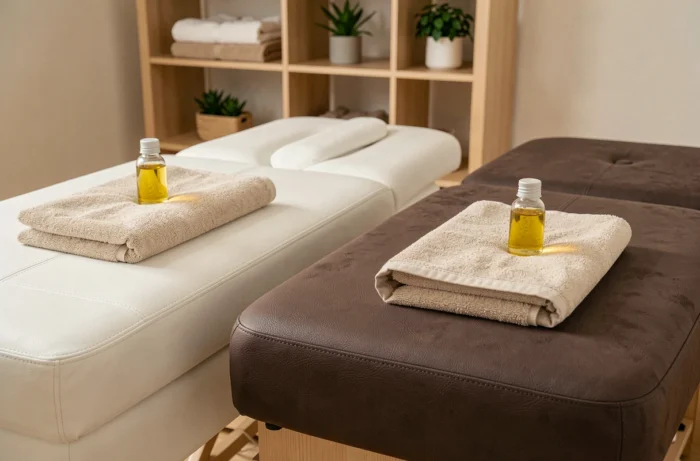
At home, one does not always think to disinfect the table between two family massages. But oils penetrate the covering if it is porous, and the smell of rancidity eventually settles in. A quick wipe with a suitable cloth after each session is enough if the covering is properly waterproofed.
Wood or aluminum structure: a choice that depends on storage
It is often said that aluminum is lighter and wood is more stable. In practice, the weight difference between the two materials is significant, but it is mainly the storage method that makes the difference.
A wooden structure (often beech or maple) results in a heavier, stiffer table, and often quieter in use. Wood absorbs vibrations better during the massage. However, if one has to store the table in a high cupboard or transport it regularly to another room, aluminum wins.
For strictly domestic use where the table remains folded in a corner of the living room or bedroom, wood offers a better stability-comfort ratio. If it is moved every week to a relative’s place, aluminum makes more sense.
Useful accessories and superfluous accessories for home massage
Manufacturers often offer packages with headrests, armrests, half-moon cushions, and transport covers. Not all these accessories are equal.
- The headrest (or facial cavity) is necessary for prone massages. One should check that its fastening system is sturdy and that the angle is adjustable.
- The half-moon cushion placed under the ankles relieves pressure on the lower back when the receiver is lying on their back. It’s a low-cost and very effective addition.
- The transport cover protects the folding table during storage and limits dust accumulation. Useful if the table remains stored for several days between uses.
- Side towel holders or removable shelves are designed for professional practices. At home, they clutter more than they serve.
The CE marking on a massage table does not automatically guarantee that it is a medical device. For personal home wellness use, this detail does not have a direct impact, but it is important to check the intended use declared by the manufacturer if one is considering regular therapeutic sessions.
Ultimately, choosing a massage table for home comes down to balancing three constraints: storage space, the size of the people being massaged, and the frequency of use. A folding wooden table with dense foam and a waterproof covering meets the majority of domestic needs. The only real pitfall is neglecting repairability and ending up with unusable equipment after two years.