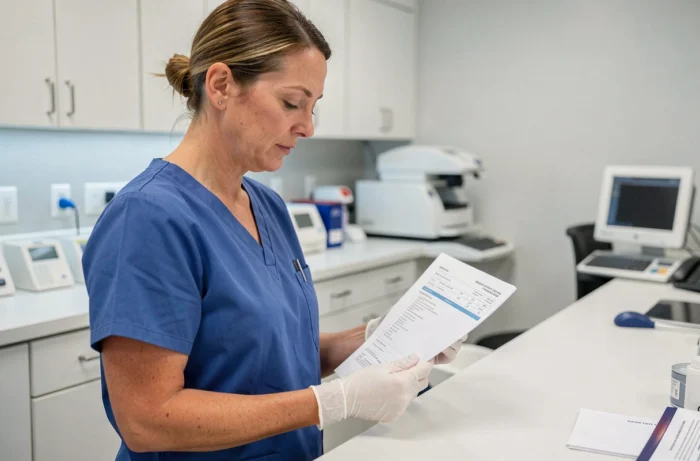
A blood test prescription is found in a drawer, dated a few months ago. The doctor had prescribed a lipid panel and a fasting blood sugar test, but the appointment at the laboratory was never made. The question quickly arises: is this document still usable, and can it be used for multiple visits to the laboratory?
What the laboratory checks before accepting a blood test prescription
Before any sampling, the medical analysis laboratory checks several elements on the prescription. The prescription date is the first criterion. A prescription for a biological examination, such as a blood test, remains valid for one year from its date of issue. After this period, the laboratory will refuse it.
The second point concerns the consistency between the requested analyses and the patient’s condition. If the doctor has prescribed a blood test in a specific context (suspected diabetes, cholesterol monitoring), the biologist may determine that the prescription no longer has medical relevance several months later, even if the one-year period has not expired.
When asking can a prescription be used multiple times for a blood test, the answer depends on what the prescriber has noted. A prescription without a renewal mention is valid for only one use. The laboratory keeps it after the sampling, and it cannot be reused for a second visit.

Renewable prescription for blood tests: how it works in practice
The doctor can include a renewal mention on the prescription. It often states “to be renewed every three months” or “test to be redone in six months.” This indication changes the entire process.
The renewal mention allows for multiple samplings with the same document, within one year after the date of issue. Each visit to the laboratory is then treated as a distinct execution of the same prescription.
In practice, the laboratory notes the date of each sampling on the prescription or in its computer system. It verifies that the frequency corresponds to what the doctor indicated. A test prescribed “every three months” will not be accepted if one presents two weeks after the previous sampling.
Case of patients with long-term illnesses
Patients with long-term illnesses benefit from a care protocol that may include regular blood tests over an extended period. The long-term illness protocol does not exempt from having a valid prescription, but prescriptions in this context are often written with integrated renewals, simplifying monitoring.
Flat-rate participation and repeated blood tests
Each act of medical biology incurs a flat-rate participation fee charged to the patient. This amount applies to each sampling, even when using the same renewable prescription for multiple visits.
For patients who undergo multiple blood tests in a year (diabetes monitoring, anticoagulant treatment, thyroid control), these flat-rate contributions accumulate up to an annual cap. Feedback on this point varies among health insurance funds, but the principle of capping is established by regulation.
- A flat-rate participation is charged at each visit to the laboratory, even with a renewable prescription.
- The annual cap limits the total contributions across all acts of biology and consultations.
- Patients with long-term illnesses benefit from an exemption for acts related to their condition.
Electronic prescription and teleconsultation: a new circuit for blood tests
Since the widespread adoption of teleconsultation, a doctor can prescribe a blood test during a video consultation and send an electronic prescription directly to the patient. This circuit modifies habits without changing the validity rules.
The electronic prescription follows the same rules as a paper prescription: valid for one year, single use unless a renewal mention is included, verification by the biologist before sampling. The laboratory accesses the document via a code or QR code sent to the patient.
This format offers a concrete advantage for recurring tests. The patient no longer needs to keep a paper document for months. The prescription remains accessible online, reducing the risk of loss or damage to the document.
Remote renewal of a biological prescription
A doctor can renew a prescription for biological tests during a teleconsultation without the patient needing to travel. This situation frequently occurs for metabolic monitoring (blood sugar, lipid panel) or post-treatment checks. The new document replaces the old one and starts a new validity cycle of one year.

When to request a new prescription for a blood test
Even if a prescription is still within its validity period, certain situations require consulting the doctor again before returning to the laboratory.
- The emergence of new symptoms that could modify the analyses to be performed.
- A change in medication that may influence the biological results.
- A previous test revealing anomalies requiring additional examinations not included in the initial prescription.
- Exceeding the one-year period since the prescription date.
The reflex to reuse an old prescription to save time may seem practical, but it exposes a real medical risk. A blood test prescribed in a given context may no longer correspond to the patient’s situation a few months later.
A relevant blood test relies on a prescription adapted to the time of sampling. The apparent time-saving of a recycled prescription does not compensate for the risk of missing a marker that should have been checked. In case of doubt about the validity or relevance of a prescription, a call to the doctor’s office is usually sufficient to clarify the situation.