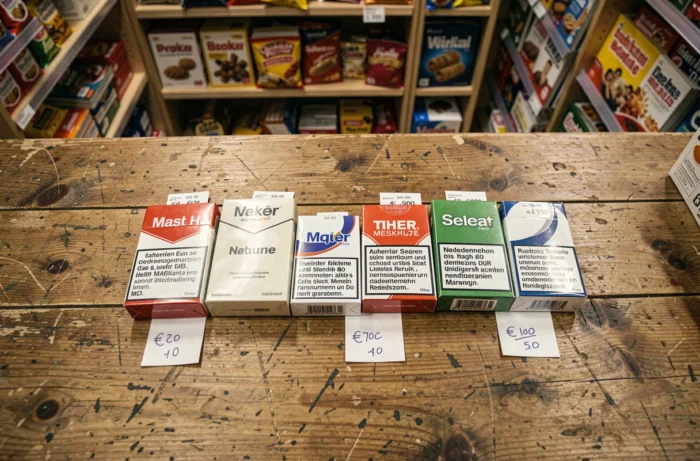
A pack of Marlboro costs about 8.20 euros in Germany, compared to over 11 euros in France. This price gap drives thousands of cross-border workers to cross the Rhine each year to buy their cigarettes. However, this differential, often perceived as fixed, is beginning to narrow due to a planned German tax reform set to continue until 2030.
German tax reform: excise taxes rising in stages until 2030
Comparisons often focus on the price displayed at tobacco shops. They overlook the mechanism that will change the game in the coming years.
Germany has initiated a multi-year reform of its tobacco excise taxes. The principle: to increase the tax in annual increments rather than all at once. By 2026, the increase will represent about 0.11 euros per pack. It seems modest, but the schedule includes regular increases until 2030.
On the tax side, the share of taxes in the price of a German pack is expected to rise from about 4 euros to 6.19 euros per pack by 2030, according to the association Generation Sans Tabac. At this rate, the pack of Marlboro could approach 12 euros in Germany by the end of the decade.
Have you ever noticed that price differences between European countries seem stable from year to year? That’s because most comparisons freeze the figures at a given moment. In reality, when comparing the price of Marlboro in Germany with that in France, the trend shows a gradual narrowing.

Marlboro, Camel, Winston: actual price differences between brands in Germany
The price of tobacco in Germany is not limited to Marlboro. Major international brands have fairly close prices, but the differences between them deserve attention.
Marlboro is positioned at the high end of the range, around 8.20 euros for a pack of 20 cigarettes. It is the price reference that most smokers use as a comparison point.
Camel and Winston are slightly below Marlboro, with a difference of a few tens of cents. This hierarchy between brands has been stable for several years. It reflects the positioning strategy of Philip Morris International, which maintains Marlboro as a premium brand.
What explains the difference between brands
The final price depends on two tax components: a specific tax (fixed amount per cigarette) and an ad valorem tax (percentage of the sale price). On a premium product like Marlboro, the ad valorem tax weighs more heavily, as it applies to a higher base price.
In practice, for the consumer, the gap between a Marlboro and a Winston remains limited. The choice of brand does not fundamentally change the monthly tobacco budget. It is the country of purchase that makes the real difference.
Comparison Germany-France: why the gap narrows each year
France applies a deliberate high-price policy. Tax increases are frequent there: in 2026 alone, three successive increases were implemented between January and March, affecting more than 500 references of packs and rolling tobacco.
As a result: the pack of Marlboro now exceeds 12 euros in France. The gap with Germany remains significant, around 28% cheaper across the Rhine according to recent surveys.
But this advantage is shrinking. Here are the factors accelerating the convergence:
- The German tax schedule includes annual increases until 2030, with a ramp-up of specific and ad valorem components
- France has already reached a high price plateau, limiting the scope for massive new increases in the short term
- The European harmonization of minimum excise taxes pushes low-tax countries upward, not the other way around
In practical terms, the savings made by buying in Germany remain real today. But they will be significantly lower in four or five years.

Rolling tobacco and alternative formats: German prices that no one compares
Most comparisons focus on the standard pack of 20 cigarettes. Rolling tobacco, packs of 25 or 30 units, and tube tobacco are rarely included, even though they represent a growing share of cross-border purchases.
In Germany, rolling tobacco remains significantly less taxed than manufactured cigarettes. The price gap with France is often more pronounced for rolling tobacco than for standard packs. This is actually the format that cross-border workers prioritize, as the gain per gram of tobacco is higher.
Legal transport limits to know
European regulations set indicative thresholds for the transport of tobacco between member states. These thresholds are often misunderstood:
- For cigarettes, the indicative threshold is 800 units (or 4 cartons of 200 cigarettes) per person
- For rolling tobacco, the indicative limit is one kilogram
- These quantities must be intended for personal use. In case of a check, customs may require proof that the purchase is not intended for resale
Exceeding these thresholds does not automatically mean an offense, but it shifts the burden of proof. It is up to the traveler to demonstrate personal use, not for customs to prove resale.
Projection 2030: a German pack at nearly 12 euros
The trajectory is set. If the German tax increments are adhered to until 2030, the price of a Marlboro pack in Germany should be around 12 euros. France, on its side, could exceed 14 or 15 euros depending on future political decisions.
The absolute value gap will persist, but in percentage terms, it will narrow from about 28% today to a tighter range. The cross-border journey to buy tobacco will become less profitable each year.
For a smoker who consumes a pack a day, the annual cost difference between the two countries will mechanically decrease. The calculation must also factor in fuel, potential tolls, and travel time, making the operation less and less advantageous for those far from the border.